



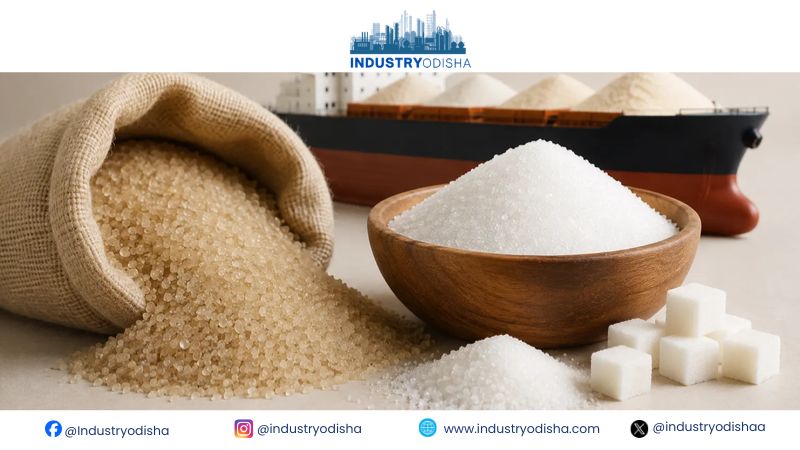
Industry Odisha Bureau, Aug 21: Owing to a sharp rise in sugar prices in the recent weeks, the Government of India (GoI) has reportedly initiated a proactive step by allowing duty-free imports of one million tonnes of raw sugar till October 31 in view of the upcoming festive season even though India has currently imposed a duty of 100% on raw sugar imports.
The Department of Food and Public Distribution (DFPD) under the Ministry of Consumer Affairs, Food and Public Distribution (MoCAF&PD) in its official social media platform X has reportedly posted that, “The ‘proactive step’ will immediately dispel speculation and ensure adequate supply to consumers at reasonable and stable prices over the coming year.”
The MoCAF&FD data has reportedly revealed that, “The retail price of sugar has risen 13% month-on-month to Rs 54.06 per kg on August 19 from Rs 47.82 per kg recently.”
Media reports have also stated that, “The GoI has also now reduced the permissible stockholding period for bulk sugar consumers to 15 days from 30 days with effect from September 1 to November 30.”
Notably, “Bulk Consumer refers to a confectioner, soft drink manufacturer, food processing company, sweetmeat seller or any other institutional buyer that consumes at least 10 tonnes of sugar per month, based on its average monthly consumption over the past year.”
Pertinent to cite here earlier media reports that, “The GoI had through a gazette notification imposed in July this year stockholding limits on sugar dealers from 1 August 1 to November 30 to curb hoarding and speculative trading ahead of the festive season. Under the earlier order, dealers were prohibited from holding sugar stocks for more than 30 days, while their inventories were capped at 4,000 quintals (40 tonnes). Besides, the GoI on May 13 this year has banned exports of raw, white and refined sugar till September 30, marking a sharp shift from the earlier restricted export regime to a prohibited category. However, the GoI has exempted exports to the US and the European Union under existing quota arrangements.”
