



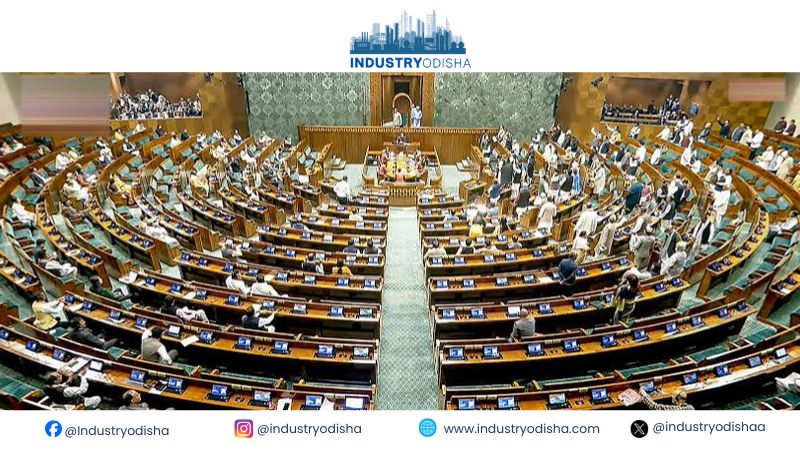
Industry Odisha Bureau, Aug 23: India’s parliamentary standing committee is renewing efforts to create a distinct classification for nano businesses within the broader MSME framework. The Rajya Sabha committee argues that the existing micro-enterprise category is too broad and fails to distinguish between subsistence-level household operations and larger micro enterprises. The committee wants the government to establish a separate category with a financial threshold around ten lakh rupees. This proposed classification would allow policymakers to target credit, subsidies and procurement support more effectively toward the country’s smallest business operators.
The debate fundamentally concerns how best to support India’s self-employed workers and extremely small household businesses. The country has approximately 92 million MSMEs, with 99.3 percent classified as micro enterprises operating below turnover of ten crore rupees. The parliamentary committee believes this broad classification makes it difficult to identify which businesses need targeted government support most urgently. Creating a nano category could enable governments to design specialized policies addressing the unique challenges faced by ultra-small enterprises.
The parliamentary panel first proposed the nano classification in March 2025 while reviewing the MSME ministry’s budgetary allocations and grants. In that report, the committee recommended establishing nano businesses with financial criteria around ten lakh rupees or less in capital investment. The proposal explicitly sought to prevent larger micro enterprises from absorbing government support intended for subsistence-level household operations and self-employed workers. The committee emphasized that this distinction could improve access to credit, government procurement opportunities, interest subsidies and business guidance.
The proposed classification addresses a persistent targeting challenge within India’s existing MSME policy architecture and support mechanisms. Businesses classified as micro enterprises can range from household kitchen operations to workshops employing dozens of people with diverse capital requirements. A household business generating fifty thousand rupees annually and a micro enterprise with five crore rupees in turnover are technically classified identically today. This breadth makes it administratively difficult to design policies that appropriately match different levels of government support to different business scales and capabilities.
The Kerala government has already demonstrated how a nano-enterprise framework could operate in practice through existing policy. Kerala introduced its nano-enterprise classification in 2021, defining nano and household units as those with fixed capital investment not exceeding ten lakh rupees. The state’s definition encompasses manufacturing, services and job-work activities classified under white or green pollution categories with connected electrical loads limited to five horsepower. Kerala’s policy provides six percent interest subsidy for three years, rising to eight percent for women entrepreneurs and enterprises operated by scheduled castes and scheduled tribes.
The Union MSME ministry has raised substantial administrative concerns about creating an additional enterprise classification beyond the existing micro, small and medium categories. The ministry argues that establishing clear and stable criteria for nano businesses would prove difficult given the fluctuating scales and seasonal patterns characterizing informal enterprises. Many nano businesses lack audited financial statements, change their activities frequently and operate without consistent annual turnover records maintainable in conventional accounting systems. The ministry contends that this administrative complexity could actually simplify governance rather than create targeted policy mechanisms.
The ministry also expressed concerns that a separate nano classification could create policy duplication across government schemes and departments operating independently. Existing programmes including PM Vishwakarma and PM MUDRA already target smaller micro enterprises and provide specialized support for specific business categories and entrepreneurship models. The ministry suggested these established schemes adequately address the needs of India’s smallest business operators without requiring additional administrative classifications or bureaucratic structures.
The parliamentary committee rejected the ministry’s objections, arguing that administrative inconvenience should not override the substantive developmental needs of India’s smallest business operators. The committee has directed the MSME ministry to form a working group involving SIDBI, the Reserve Bank of India, state governments and experts on informal enterprises. This group would develop workable frameworks for identifying and supporting nano businesses while addressing the ministry’s legitimate administrative and policy concerns simultaneously.
Economic experts emphasize that nano enterprises are not necessarily homogeneous in their characteristics, trajectories or support requirements within the economy. Some nano businesses operate primarily to provide household income and sustain livelihoods for self-employed workers lacking adequate wage employment opportunities elsewhere. These livelihood-oriented enterprises typically require basic credit access, interest support, minimal training and market connections for survival and stability. Other nano businesses possess growth potential and could eventually expand, employ additional workers, increase production capacity and graduate into larger formal enterprises.
The policy challenge therefore involves designing differentiated support mechanisms that recognize these distinct entrepreneurial patterns and economic trajectories among nano-business operators. Livelihood businesses might benefit most from consistent credit access and interest subsidies whereas growth-oriented enterprises could benefit from expansion capital, technology transfer and market linkages. Targeting policy effectively requires distinguishing between businesses that fundamentally operate at subsistence level and those with expansion potential.
The parliamentary committee’s proposal fundamentally reflects a tension between effective policy targeting and administrative simplicity that pervades India’s business support architecture. The nano category could potentially improve targeted support for India’s poorest and most marginalised business operators. However, creating workable administrative mechanisms for identifying and supporting such extremely small enterprises remains genuinely challenging. Whether the government can design policies that are both sufficiently targeted and administratively feasible remains the central unresolved question in this emerging policy debate.
