



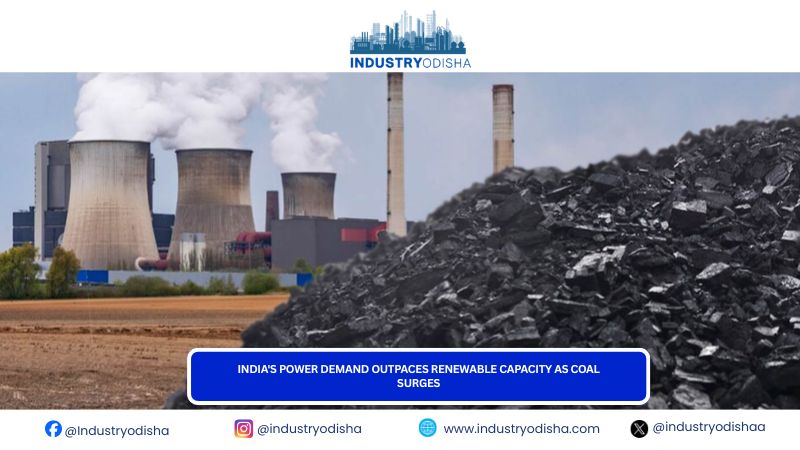
Industry Odisha Bureau, Aug 3: India’s reliance on coal production to meet electricity demand reveals the persistent tension between rapid industrialisation and long-term energy transition. When weather patterns deviate from historical norms, the nation’s energy infrastructure defaults to familiar levers: accelerating coal extraction and dispatch to compensate for fluctuations in supply-demand dynamics.
July’s production surge emerging amid deficient monsoons and cooling-driven electricity demand illustrates this structural reality. Below-average rainfall reduced hydroelectric generation capacity at a moment when air-conditioning consumption, industrial activity and urban growth pushed power demand upward. The system responded by mobilising domestic coal reserves, signalling that despite expanding renewable capacity, fossil fuels remain the ballast stabilising India’s electricity grid during supply shocks.
Power consumption during June had already climbed 11% annually, reaching 170.7 billion units as cooling loads intensified across residential and commercial sectors. This demand pressure carried into July, requiring coal dispatches to compensate for weather-dependent generation sources. The Coal Ministry’s provisional data captured the scale of the adjustment: dispatches jumped 17.34% to 86.33 million tonnes, substantially outpacing production growth of 7.5% to 69.75 million tonnes.
Coal India Ltd., the nation’s dominant mining enterprise, contributed 50.35 million tonnes of output a modest 8.42% year-on-year increase while supplying 63.67 million tonnes for dispatch. This gap between production and dispatch quantities reflects the sector’s accumulation of inventory during lower-demand periods and accelerated mobilisation during peaks.
The divergence between production and dispatch growth carries strategic implications. Narrowing the gap requires sustained investment in mining infrastructure, railway evacuation capacity, and thermal power plant efficiency. India’s ongoing commercial coal mining reforms and mine modernisation initiatives address this bottleneck, yet seasonal spikes expose limitations in logistics networks designed for average demand rather than cyclical peaks.
The broader challenge confronting India’s energy architecture is reconciling rapid economic growth with carbon transition commitments. Coal production increases driven by temporary weather anomalies underscore that renewable integration, grid-scale battery storage, and pumped hydro capacity development remain incomplete. Building on recent coal sector reforms, further gains could come through accelerated mine mechanisation, enhanced demand forecasting systems, and strategic battery storage deployment to smooth seasonal volatility.
As India pursues simultaneous objectives industrial competitiveness, energy security and decarbonisation data like July’s dispatch surge illustrates the complexity of managed energy transition. The near-term reality demands reliable coal availability; the longer-term imperative demands accelerated clean energy infrastructure.
