



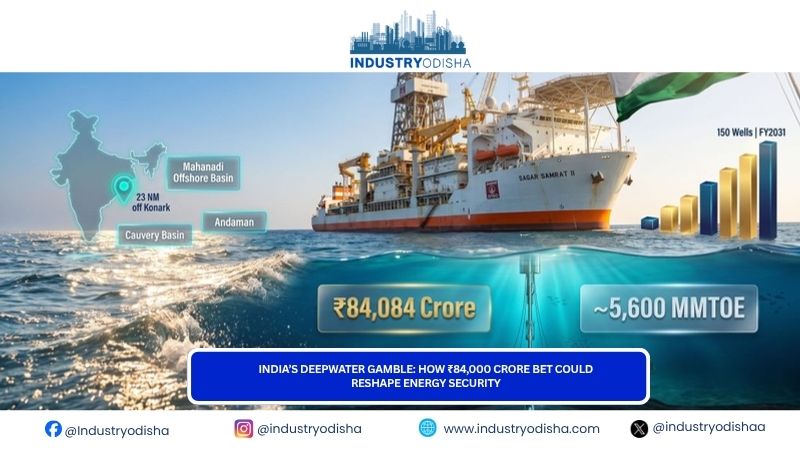
Industry Odisha Bureau, Aug 2 :- India faces an energy paradox. Despite possessing vast offshore hydrocarbon potential across the Krishna-Godavari, Cauvery, Mahanadi, and Andaman basins, the nation remains heavily dependent on imported crude oil a vulnerability that strains both currency reserves and strategic autonomy. Now, a substantial government investment aims to transform that dependency into domestic capacity.
The challenge underlying this ambition is starkly economic. Drilling a single deepwater exploratory well costs between $125 million and $150 million, with geological uncertainty compounding the financial risk. Exploration blocks typically require five to ten years before yielding commercial production, creating a capital-intensive, multi-decade commitment that private investors have been reluctant to shoulder alone. Meanwhile, India’s existing oil and gas fields naturally decline by roughly 6–7 percent annually, making frontier exploration not a luxury but a necessity.
Enter Samudra Manthan, the Union Cabinet’s National Offshore Exploration Scheme approved in late July, with an ₹84,084 crore allocation extending through fiscal year 2031. Rather than relying solely on state enterprises, the programme employs a risk-sharing mechanism designed to attract sustained private capital into deepwater ventures. The government will cover up to 50 percent of eligible drilling costs per well, capped at ₹675 crore, fundamentally reshaping the investment calculus for private operators.
The scheme’s four-pillar structure addresses distinct exploration bottlenecks: ₹28,534 crore funds advanced seismic data acquisition the critical first step in mapping subseabed hydrocarbon deposits. An additional ₹43,200 crore targets drilling sixty deepwater exploration wells, the programme’s operational centerpiece. Simultaneously, ₹10,000 crore will develop common offshore infrastructure hubs to commercialise discoveries, while ₹2,000 crore supports domestic manufacturing of oilfield equipment.
State-owned operators are moving in parallel. Oil and Natural Gas Corporation has charted plans to drill 150 deepwater wells over seven years, tapping an estimated 5,600 million metric tonnes of oil equivalent. Oil India’s recent natural gas discoveries at Vijayapuram-2 and Vijayapuram-3 in the Andaman frontier demonstrate early momentum. Recent licensing rounds have offered additional deepwater and ultra-deepwater acreage to qualified bidders.
The programme’s ambition is quantifiable: increasing domestic production from 62 million metric tonnes of oil equivalent to 80 annually, while expanding the hydrocarbon resource base from 1.6 to 2.2 billion tonnes of oil equivalent. Government estimates suggest the resulting production could reduce annual crude oil imports by approximately ₹1 lakh crore a substantial reallocation of national resources toward domestic development and away from foreign exchange outflows.
Building momentum beyond these initial wells will require strengthening offshore service ecosystems, expanding indigenous drilling expertise, and accelerating technological capabilities opportunities to deepen India’s emerging position as a consequential offshore energy frontier.
