


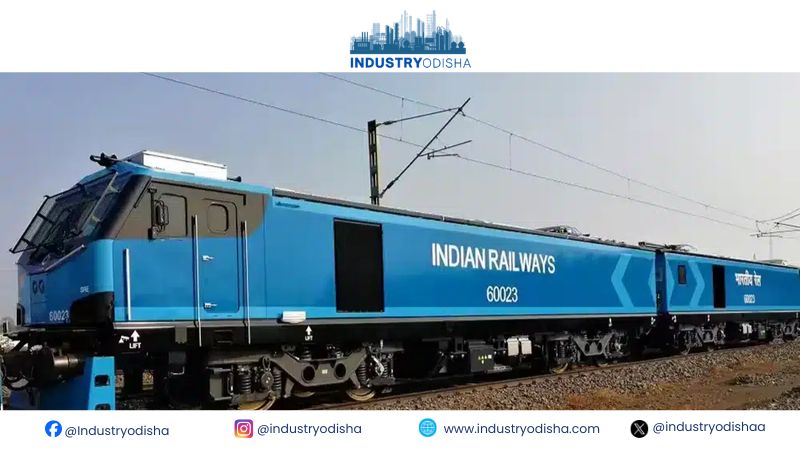
Industry Odisha Bureau, Sep 07: There’s a telling detail buried in Satish Kumar’s Sunday briefing in Indore, India’s hydrogen train has already proven it can hit 120 kmph in trials, yet Railways isn’t rushing to run it that fast commercially. The target being set is 110 kmph deliberately lower than what the technology has already demonstrated. That gap between what’s been tested and what’s being planned says something about how cautiously this technology is being rolled out.
Why the speed ceiling is coming down, not up
Since its July 17 launch on the 89-km Jind-Sonipat corridor in Haryana, the train has run at a modest 75 kmph. Trials pushing it to 120 kmph were a proof of concept evidence the hardware can handle higher speeds. But moving from “can do it once under test conditions” to “will do it every day in commercial service” is a different engineering problem entirely, and 110 kmph looks like the railway’s calculated middle ground: fast enough to be operationally meaningful, conservative enough to leave a safety margin.
What’s notable is that Kumar didn’t frame this as a technology question alone. He specifically flagged that stakeholder consultations are underway to figure out which rail sections can actually support the train, and that fuel supply logistics are still being worked out. That’s arguably the harder problem. A hydrogen train is only as useful as the refuelling infrastructure built around it unlike an electric train, which can draw power from any electrified line, a hydrogen fleet needs dedicated fuel supply chains wherever it runs. Scaling beyond one 89-km route depends entirely on solving that logistics puzzle, not just the propulsion engineering.
What’s actually novel here
The technology itself deserves a beat of explanation, because it’s genuinely different from anything else on Indian tracks. Instead of drawing power from overhead wires like a conventional electric train, the Hydrogen Fuel Cell Trainset produces its own electricity onboard hydrogen and oxygen combine in a fuel cell, and the only by-products are water vapour and heat. No combustion, no tailpipe emissions. It’s essentially carrying its own power plant rather than tapping into the grid, which is precisely why it can run on routes without electrification and precisely why fuel logistics become the bottleneck instead of wiring.
The bigger fleet story running alongside it
The hydrogen train isn’t happening in isolation. Kumar’s briefing also touched on Indian Railways’ much larger Vande Bharat sleeper rollout one sleeper set already running between Howrah and Kamakhya, four more built and awaiting launch, and 200 total units in production under a public-private partnership, each taking roughly a year to eighteen months to build. That’s a fleet-modernisation programme operating at an entirely different scale than the single-route hydrogen experiment. Reading the two side by side is useful: Vande Bharat sleepers represent proven technology being manufactured at volume, while the hydrogen train represents unproven technology being tested cautiously on one line before any talk of scaling.
There were smaller but telling details too AI-linked CCTV for station and train security, and even a mention of addressing rodent problems onboard, which is a mundane reminder that railway modernisation isn’t only about headline technology but ordinary operational fixes. Regional infrastructure commitments, including special trains planned for Ujjain’s 2028 Simhastha festival and progress on the ₹18,500-crore Indore-Manmad line, rounded out the briefing but sit clearly outside the hydrogen story.
The real signal
Strip away the surrounding announcements and the core message is this: Indian Railways has hydrogen propulsion working, has pushed it past the speed it intends to run commercially, and is now spending its effort on the unglamorous groundwork route selection, fuel supply, technical validation that determines whether this becomes a genuine second mode of traction or stays a single-route demonstration. The 120 kmph trial was the easy part. Getting to sustainable 110 kmph operations, with fuel infrastructure to match, is the actual test of whether hydrogen has a real future on Indian tracks.
