



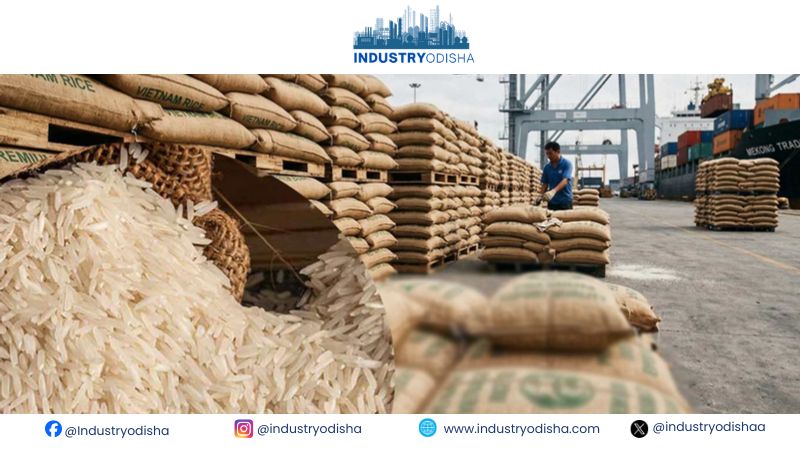
Industry Odisha Bureau, Sep 11: Indian rice export prices touched a one-year high this week. Tightening supplies and monsoon concerns are driving the move. Traders are watching the summer-sown crop closely.
Monsoon Tightens the Outlook
Below-normal rainfall is at the centre of the story. August precipitation came in 16% below normal, the weather department said. September rainfall is also expected below average. “Crop production estimates are being revised lower,” a Kolkata-based dealer said, citing the widening rainfall deficit. This reflects tightening expectations, not a confirmed crop failure.
Prices Reach a One-Year High
India’s 5% broken parboiled rice was quoted at $371-$377 a tonne this week. That’s up from $369-$375 the previous week. Indian 5% broken white rice traded at $368-$373 a tonne. The increase is modest week-on-week. Its significance lies in reaching a one-year peak.
India Still Undercuts Regional Rivals
Despite the rise, Indian rice remains far cheaper than competitors. Vietnam’s 5% broken rice was offered at $440-$445 a tonne. Thailand’s equivalent grade reached about $488 a tonne. That gap gives Indian exporters a meaningful price edge. Buyers, though, also weigh quality, variety and shipping terms. A lower price alone doesn’t guarantee shifted demand.
Vietnam and Thailand Face Their Own Pressures
Vietnam’s market is moving on separate dynamics. Domestic supplies are falling as the summer-autumn harvest nears its end, a Ho Chi Minh City trader said. Demand is softening at the same time, the trader added. The Philippines is buying more rice overall, but largely from other suppliers. Vietnam’s full-year rice exports are estimated at 7.74 million tonnes, state media reported.
Thailand’s prices climbed too, from $483-$485 to about $488 a tonne. Traders linked this to expectations of continued lower output. Neither country’s shift stems from India’s supply situation.
Bangladesh Tightens Its Own Exports
Bangladesh has cut approved aromatic rice export volumes in half. This comes amid high domestic prices and fears of further increases. The government had approved 45,270 tonnes for export. Only 2,419 tonnes had shipped by August 30. Revised rules now require a minimum export price of $1.60 per kilogram. Customs quality checks and repatriation of earnings are also mandated. Bangladesh’s move reflects domestic price concerns, separate from India’s market.
A Fragmented Regional Picture
Asia’s rice exporters are currently facing different conditions. India grapples with rainfall uncertainty and tightening domestic supply. Vietnam sees falling output alongside falling demand. Thailand’s prices reflect output expectations rather than immediate shortages. Bangladesh is prioritising domestic price stability over export volumes.
What It Means for India
India’s price advantage over Vietnam and Thailand remains substantial for now. Whether that holds depends heavily on how the monsoon plays out. Tighter domestic supply could yet complicate the export picture further.
