


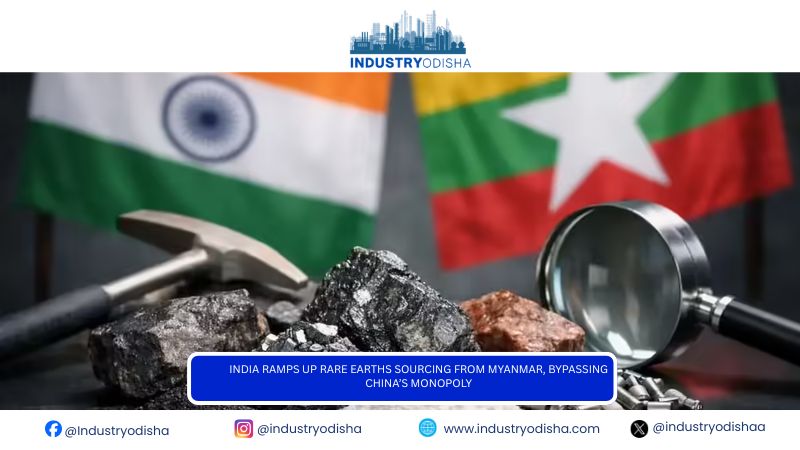
Ambassador Abhay Thakur signals New Delhi’s strategic pivot at Mandalay mining forum; two delegations in seven months reflect urgency to secure critical minerals.
India is pursuing a deliberate strategy to source rare earth minerals from Myanmar, moving beyond diplomatic overtures to direct engagement with mining operations and rebel-controlled territories—a stark indication of how critical New Delhi views breaking free from Chinese control of the sector.
The push came into sharp focus this week when India’s Ambassador to Myanmar, Abhay Thakur, addressed the opening of a mining forum in Mandalay, announcing that cooperation between New Delhi and Naypyidaw has “picked up significantly in the last two years.” Thakur specifically cited two Indian delegations focused on rare earths and critical minerals: one in December 2024 and another as recently as February 2026.
The elevation of the issue underscores its importance. During Myanmar’s President Min Aung Hlaing’s official visit to India in May and June, rare earths cooperation rose on the diplomatic agenda—moving the discussion, as Thakur put it, beyond technical-level conversations to higher political levels.
The Prize: Half the World’s Heavy Rare Earths
Myanmar’s Kachin state, located in the country’s northern region near the Chinese border, is the target. Mines there supply almost half of the world’s heavy rare earths—minerals essential for manufacturing permanent magnets used in electric vehicles and wind turbines. Historically, these minerals have been shipped to China for processing, concentrating global supply chain control in Beijing’s hands.
Indian Companies Enter the Field
Six Indian companies were specifically named by Ambassador Thakur as participants at the Mandalay forum: state-owned IREL, NTPC Mining, Himadri Specialty, Oceanic Sands, PrNd Metal & Magnets, and Jai Puri Holdings. Additionally, Midwest Advanced Materials has maintained close engagement with Myanmar “in recent months and years,” though Thakur did not disclose specifics of that engagement.
According to Reuters reporting, state-owned IREL and private firm Midwest Advanced Materials have been considering the mechanics of collecting and transporting mineral samples from mines under the control of the Kachin Independence Army (KIA)—the armed rebel group that controls Myanmar’s primary mining operations near the Chinese border.
Engaging the KIA: India’s Unconventional Path
India’s willingness to work with the KIA, a non-state actor, signals the urgency of its minerals strategy. Reuters has previously reported that India has sought rare earth samples through the KIA, a detail that indicates New Delhi views access to these materials as worth navigating complex political and security arrangements.
The “unglamorous, granular work” of sample collection and transport from KIA-controlled mines sits in stark contrast to the diplomatic language of “win-win opportunities” deployed at Mandalay.
Uncertain Outcomes
Whether India’s two-year effort will yield a stable, reliable supply chain remains unclear. Myanmar’s mining sector faces political volatility, and China’s substantial influence over the country could complicate New Delhi’s strategy. The success of India’s rare earths pivot will ultimately depend on whether the mineral samples collected actually contain the materials in the quantities and quality needed to justify long-term investment and processing infrastructure.
