



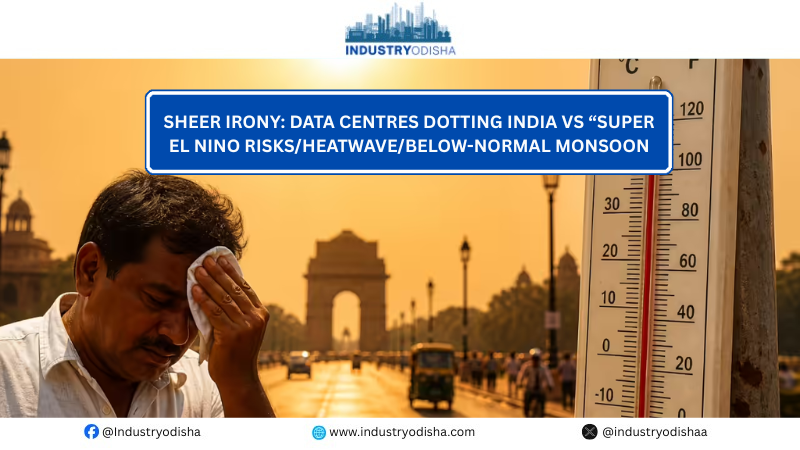
Industry Odisha Bureau, May 3: On the one hand, India is reportedly experiencing a massive data centre boom and transforming into a global digital hub, the requisite ‘absorption chillers’ installed there require more consumption of water.
On the other hand, not only ‘Super El Nino’ risks looming large over India this year (that is already being bitterly experienced in shape of intense heatwave sweeping across the country), but also IMD’s forecast of below-normal monsoon means acute water scarcity lurking in the face.
Owing to a potentially strong ‘Super El Nino’ (warm Pacific Ocean) risks in India, the higher temperatures would definitely have a higher cooling demand by the data centres in India. It is because, most data centres in India reportedly use ‘evaporative cooling system’ (Absorption Chiller) which is a technology reportedly used in high-temperature environment like that of India.
However, the startling revelation reads: “Water removes heat from the servers of the data centres in India, and roughly 80 per cent of the water evaporates and is lost. Karnataka’s IT Minister Priyank Kharge told the state assembly in March 2026 that each megawatt of data centre capacity requires 25 million litres of water per year. As India’s current operational capacity is 1.5 gigawatt, it implies 37.5 billion litres of water annually for the data centres alone.” (Courtesy: Noted public policy researcher Sagari Gupta’s article published in the ‘Down To Earth’)
Madam Sagari Gupta in her same article has mentioned: “Bengaluru’s data centres are concentrated in its most water-stressed eastern and southeastern corridors. Hyderabad faces a projected water deficit of 870 million litres per day by 2027. Chennai hit Day Zero in 2019 when its four main reservoirs fell below one per cent capacity. Mumbai and Chennai together account for 70 per cent of India’s total data centre absorption in 2025, according to Savills India. These are not cities with water to spare”.
Reports further reveal”, “Since India is experiencing a massive data centre boom, transforming into a global digital hub for catering to the needs of a growing digital economy, 5G rollout, and AI adoption, the industry is projected to grow fivefold by 2030 to over 8 gigawatt (GW) driven by a potential $30 billion in investment”.
As per the information available in ‘Vamtec.com’: “Absorption Chillers provide effective cooling for overheated data centres to optimise high performance there. Overheating is a major issue in high-performance computing, leading to equipment failures, data loss, and increased operational costs. As data centres grow in size and capacity, the need for efficient cooling solutions becomes more pressing. Absorption chillers are a cutting-edge solution that offers efficient and sustainable cooling to keep data centres running optimally.”
On the contrary, the India Meteorological Department (IMD) forecasts “a below-normal monsoon in India for 2026, with rainfall predicted at 92% of the Long Period Average (LPA)”.
It implies acute water scarcity, drought-like conditions and reduced agricultural output.
The million dollar question arises: When pan-India would be reeling under water shortage, will there be adequate water available for keeping our data centres cool as well as intact and insulated to avert ‘equipment failures’, ‘data loss’, and ‘increased operational costs’?
