



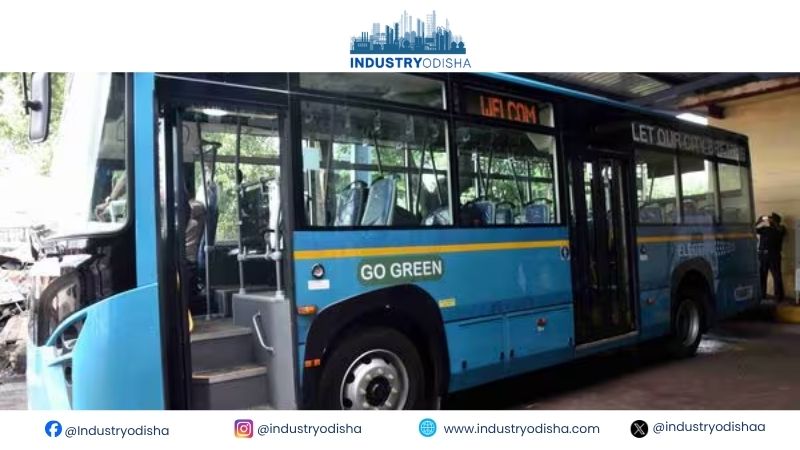
Bhubaneswar,August 31:-The Centre is considering interest subvention for electric-vehicle charging infrastructure. This support could accompany its proposed financing scheme for e-buses and e-trucks. Commercial operators face charging costs beyond simply purchasing new vehicles. The move could address a significant barrier facing electric-mobility adoption.
The proposed scheme, discussed since early 2026, was pegged around ₹9,852 crore. It aims to support 50,000 e-buses and 50,000 e-trucks nationally. This rollout is envisioned over a five-year implementation period. Interest subvention and credit guarantees remain the proposal’s core financing mechanisms.
Operators currently face a second major capital requirement beyond vehicle costs. They must either install depot chargers or partner with charging operators. Bundling vehicle financing with charging support could ease this dual burden. Government officials say charging incentives are actively under discussion currently.
India has 67,657 public EV chargers, according to compiled data. However, high-capacity charging remains genuinely limited across the network. Only 534 chargers offer 121-240 kilowatt capacity, roughly 0.7% overall. Just nine chargers exceed 240 kilowatts, representing a mere fraction nationally. Faster charging particularly matters for large commercial vehicles like buses.
India ranks as the world’s third-largest e-bus market currently. Sales rose 81% to 3,644 units during FY24 first. They then dipped 6% before rebounding 37% to 5,356 units. PM E-DRIVE, launched in 2024, first supported electric-truck adoption specifically. Its ₹500 crore budget targets 5,643 e-trucks through FY28.
Only 52 e-trucks had received incentives by late August. Limited heavy-truck availability and scrapping-certificate hurdles slowed early uptake somewhat. PM E-DRIVE separately allocated ₹2,000 crore for charging-infrastructure subsidies nationwide. Yet only ₹689 crore has been sanctioned for 6,562 chargers.
Industry expert Sharif Qamar noted that charger investments remain distinctly capital-intensive. He said bundled incentives could meaningfully accelerate India’s commercial-EV ecosystem growth. Success would also support reduced crude-oil dependence and cleaner transport. The next policy phase could further broaden support across financing and infrastructure together.
