



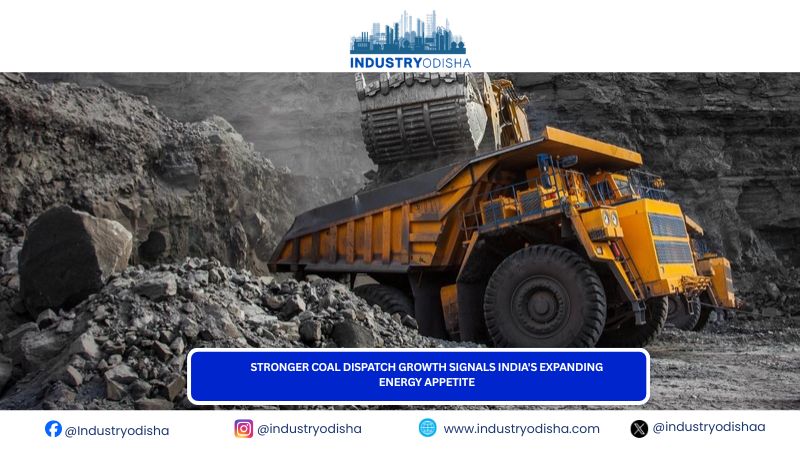
Industry Odisha Bureau, Aug 7: India’s electricity challenge is not scarcity but satiation. As the economy grows faster than historical trends and manufacturing expands across regions, power demand rises in ways that test the supply chains feeding the grid. This is why the numbers emerging from India’s coal sector this quarter matter less for what they report than what they reveal about the capacity to move fuel from mines to power stations reliably.
The latest inventory data 148 million tonnes of coal distributed across thermal plants, pitheads, and transit routes provides a comfortable two-month cushion against consumption shocks. That sufficiency matters, particularly during summer when air conditioning demand spikes and during monsoon when hydroelectric generation falters. But the more significant signal lies in dispatch growth: coal movement increased 17.34 percent year-on-year during July alone, substantially outpacing production growth of 7.51 percent during the same period.
That divergence reflects efficiency. India’s coal sector has been gradually solving a half-century-old problem: moving coal from mines in central India to power plants distributed across the country with minimal delay. July’s dispatch figures 86.33 million tonnes shipped against 69.75 million tonnes produced suggest the solution is working. Higher dispatch can exceed production in any given month because accumulated inventories fill the gap; over full fiscal years, the relationship inverts. But the steady-state message is clear: infrastructure improvements are permitting faster fuel turnover.
That efficiency has become structural. Year-to-date, coal dispatches through July show 5.87 percent growth, demonstrating that July’s jump reflected acceleration rather than seasonal anomaly. Railway corridors dedicated to coal, coal-handling infrastructure at mines and power plants, and commercial mining reforms creating faster production ramps all contributed to this trajectory.
The backdrop matters. India’s electricity demand has grown faster than analysts expected. Manufacturing has concentrated in specific regions, creating logistics bottlenecks. Renewable energy, expanding rapidly, has variable output requiring thermal plants to provide reliable baseload generation and flexibility simultaneously. Under these pressures, an unreliable coal supply chain would create real risk involuntary load-shedding, industrial shutdowns, or prices so high that manufacturers relocate. India’s competitors face energy constraints; India cannot afford to be one of them.
The question now is whether the trend line continues. Production at domestic mines must keep accelerating to meet growth. Logistics infrastructure must stay ahead of volume. Inventory management must become more sophisticated, not merely larger. Storage at thermal plants costs money; every ton sitting at a power station is capital not generating returns.
Building on recent progress, the next phase could involve deepening digital mine oversight to accelerate extraction, expanding railway capacity on key corridors, and improving forecasting models that predict demand spikes and trigger production adjustments before shortages materialise. These are not heroic measures. They represent the technical frontier of making energy security habitual rather than aspirational
which is precisely what a growing economy requires.
