



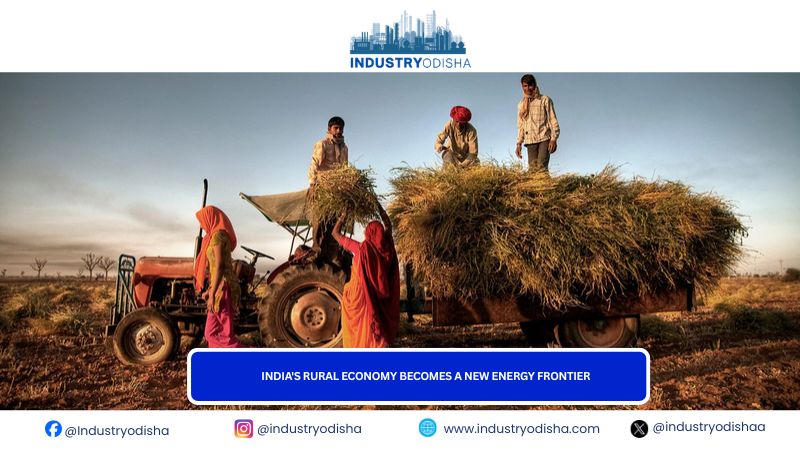
Industry Odisha Bureau, Aug 7: India is betting that its most abundant resource agricultural and organic waste can become a pillar of energy independence. The bet rests on an audacious arithmetic: scaling compressed biogas production roughly tenfold over the next decade by turning what farmers burn or discard into a commodity that fuels vehicles and heats homes.
That ambition crystallised this week when India’s government approved a ₹23,731-crore programme designed to engineer what markets alone have not achieved a thriving, self-sustaining biogas industry woven into rural economies and urban energy infrastructure. The National Circular Bioenergy Scheme, operative until 2036, represents a carefully constructed bet that waste-to-energy can work at scale when policy removes friction, guarantees returns, and builds connecting tissue between producers and consumers.
The maths are unforgiving. India has about 300 compressed biogas plants today. Moving toward 5,000 plants requires solving three problems simultaneously: making it profitable for entrepreneurs to build plants, ensuring farmers and rural collectors have incentive to aggregate feedstock, and guaranteeing the gas reaches markets reliably. Failure in any dimension collapses the whole logic.
The scheme addresses this with precision. It establishes an administered price of ₹2,110 per MMBTU high enough to reward producers but structured to remain affordable. It guarantees offtake, removing the risk that plants sit idle while searching for buyers. It funds up to ₹2 crore per tonne per day of capacity, absorbing the capital burden that deters entrepreneurs. And it explicitly finances the infrastructure most schemes ignore: feedstock aggregation, equipment, and the pipeline networks that connect rural biogas production to city gas distribution systems.
That last element matters profoundly. Pipeline connectivity transforms economics. It reduces evacuation costs, expands market reach beyond immediate localities, and permits reliable bulk evacuation the difference between a marginal venture and a scalable business. The scheme supports both cluster-based and standalone infrastructure, recognizing that optimal solutions vary by geography and feedstock density.
Raw materials abound. Agricultural residues, cattle dung, sugar-industry waste like press mud, and municipal organic waste all feed anaerobic digesters. The process yields compressed biogas suitable for blending into compressed natural gas and piped natural gas networks essentially making it interchangeable with fossil gas from the perspective of existing infrastructure.
The expected cascades are substantial. Farmers gain supplementary income from waste they might otherwise burn. Rural entrepreneurs gain entry into clean energy production. Existing gas distribution networks multiply their domestic feedstock without costly overhaul. The country reduces dependence on imported fossil fuels. Greenhouse gas emissions fall. Organic fertilizer the digestate residue becomes a tradeable product, enhancing agricultural productivity.
The Indian Biogas Association estimates that reaching 5,000 operating plants could generate employment across rural India on a significant scale. But that forecast depends on execution. The next phase will reveal whether policy architecture translates into field reality whether capital flows, projects complete on schedule, feedstock aggregates reliably, and markets absorb the growing gas supply at administered prices. Those are the binding constraints that determine whether GOBARdhan succeeds as strategy or remains a well-designed framework without momentum.
