



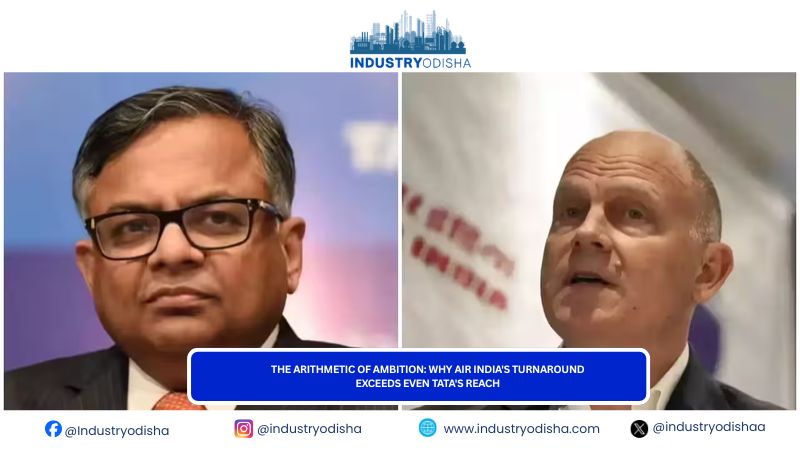
Industry Odisha Bureau, Jul 31: Few corporate transformations demand as much patience as rebuilding a full-service international airline. Air India is learning this lesson through costly experience, having accumulated nearly ₹59 billion in losses since its October 2021 privatization despite the intervention of one of India’s most capable industrial groups.
The financial hemorrhaging has become difficult to obscure. In the fiscal year ending March 2026, the airline recorded its worst annual deficit on record, exceeding ₹26 billion, dragging down the returns of Singapore Airlines, which holds a quarter of the carrier’s equity. These numbers have forced management to implement measures more commonly associated with crisis management: halting salary increases, reducing compensation for senior staff, renegotiating supplier contracts, and dismantling the discretionary spending that had become institutionalized during the airline’s government ownership era.
Yet the financial pressure, while severe, represents only part of the challenge confronting Air India’s leadership. The airline is simultaneously navigating a leadership transition at precisely the moment when organizational stability matters most. CEO Campbell Wilson informed the board of his intention to depart in 2024 but agreed to remain until a successor could be identified a gap that has extended nearly to 2026, creating months of strategic uncertainty. Air India’s response, announcing the formation of an interim management committee, has drawn skepticism from industry observers accustomed to more decisive executive transitions.
The appointment of a former Civil Aviation Secretary as executive advisor to the chairman has sparked its own controversy. Airline specialists question whether returning to government officials can accomplish as privatized management what broader structural changes have not already addressed, suggesting the airline may be attempting to engineer solutions through administrative reshuffling rather than operational reform.
What emerges from these developments is a growing consensus among aviation professionals that Air India’s impediments run deeper than operational execution. Governance failures poor succession planning, delayed decision-making, organizational inertia increasingly appear to be constraining progress more than capital constraints or competitive pressures. The airline’s effort to modernize by shedding experienced staff in exchange for a younger workforce has paradoxically eroded the institutional knowledge required to execute transformation itself.
Tata Group Chairman N. Chandrasekaran’s recent acknowledgment that comprehensive turnaround could extend beyond a decade substantially longer than industry observers had anticipated signals an important recalibration of expectations. It also underscores an uncomfortable truth: even competent ownership and sufficient capital cannot accelerate fundamentally difficult organizational transformations indefinitely. Air India’s journey suggests that rebuilding India’s most significant airline will demand sustained commitment beyond typical corporate planning horizons.
