


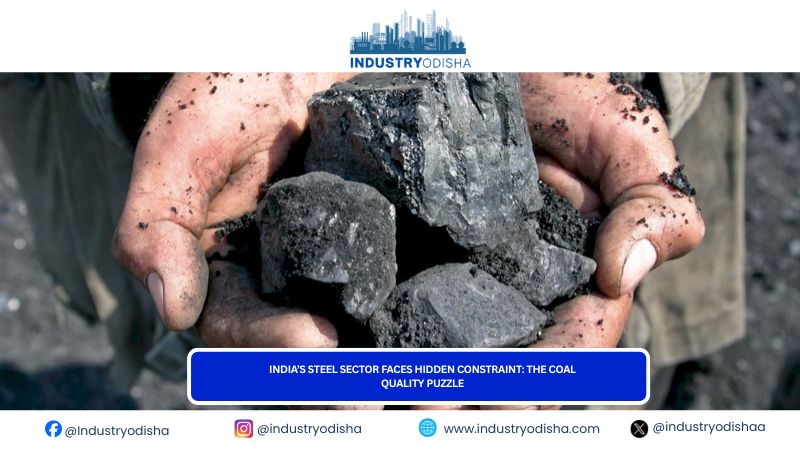
Industry Odisha Bureau, Jul 30: India’s ambitious expansion of steel production faces an unlikely bottleneck: not the lack of coal itself, but its quality and the aging infrastructure that processes it. As the country pursues greater industrial self-reliance and global manufacturing competitiveness, a critical vulnerability persists in the middle of the coal value chain the washing and beneficiation facilities that transform raw mineral into production-ready fuel.
The gap between potential and performance is stark. Coal India’s beneficiation capacity stands at 18.35 million tonnes annually, yet actual output of washed coking coal reached just 3.59 million tonnes recently, revealing an underutilized infrastructure that speaks to deeper operational challenges.
The issue centers on coal composition. India’s domestic reserves contain abundant coal with high ash content mineral impurities that compromise steelmaking efficiency. Unlike developed economies with abundant low-ash deposits, Indian steelmakers must either wash and blend lower-grade coal with imported high-quality alternatives or import finished coking coal at considerably higher cost. That dependence on foreign supplies constrains both margins and energy security in a sector critical to India’s manufacturing ambitions.
Behind the utilization gap lies aging infrastructure. Many of Coal India’s washing facilities were designed decades ago and now operate with outdated technology, creating cascading problems. Washeries sit idle or underutilize capacity when raw coal arrives inconsistently from mine pitheads. Some facility designs prove incompatible with the particular characteristics of supplied coal. The result is a system operating well below its nominal capability a costly inefficiency that ripples through steel manufacturers’ production schedules.
A parliamentary committee examining the sector has identified modernization as essential. Upgrading aging beneficiation infrastructure to current technological standards could unlock substantial productivity gains. Equally important, the committee suggests repositioning washeries closer to coal extraction sites themselves.
Pithead beneficiation addresses multiple challenges simultaneously. Processing coal immediately at the mine removes ash and impurities before transport, reducing logistics costs and railway congestion. Washed coal weighs less and occupies less cargo space an efficiency gain that multiplies across India’s vast coal transport networks. Environmental benefits accrue as well; fewer tonnes of raw coal must move by rail, lowering emissions and reducing infrastructure wear.
First-mile connectivity the critical link between pit and processing remains unevenly developed. Future washery development must align with mine expansion plans and improved connection infrastructure, creating an integrated supply chain rather than disconnected facilities.
For steelmakers seeking to compete globally, reliable access to consistent, quality domestic coking coal would reshape economics. That transformation requires not revolutionary change but systematic modernization of existing capacity the infrastructure foundation upon which India’s steel ambitions ultimately rest.
