



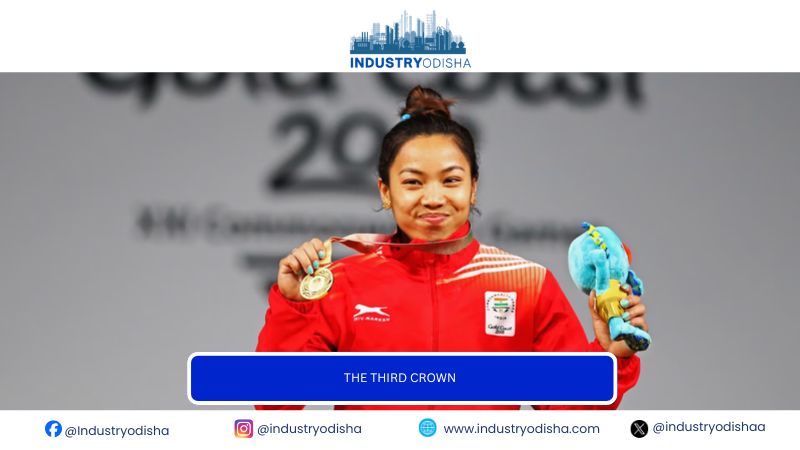
Industry Odisha Bureau, Jul 27: Mirabai Chanu stepped onto the platform in Glasgow as India’s weightlifting establishment: three-time Commonwealth medallist, Olympic silver winner, a fixture on the world stage. What she produced was precisely what the role demanded another gold, and another statement about sustained excellence in a sport that rarely tolerates decline.
At 31, competing in the women’s 48kg category, Chanu delivered 190kg across the two disciplines that define elite weightlifting: snatch and clean and jerk. The execution mattered as much as the total. An opening snatch attempt at 82kg failed, a momentary stumble quickly corrected. She recovered to lift 85kg, resetting the Commonwealth Games record in the process. By the time she approached the clean and jerk, the outcome was almost secondary to the demonstration this was an athlete reinforcing her station, not simply winning a competition.
Her third consecutive Commonwealth Games gold encapsulates something deeper than individual achievement. Since winning silver at Glasgow 2014, Chanu has authored a trajectory that traces India’s own rising standing in international sport. The 196kg victory at Gold Coast four years later announced a new standard. Birmingham 2022 brought 201kg and another gold, India’s opening medal at those Games. Now, in the final competition before Paris Olympics, she delivered again with the precision of someone who understands what it means to be a flagship athlete.
The Commonwealth platform has become Chanu’s proving ground, a space where consistency matters more than dramatic breakthroughs. Four consecutive appearances yielded three golds and one silver a record that positions her among India’s greatest athletes across any sport. Her Olympic silver and World Championships medals elsewhere speak to broader excellence, but these Commonwealth moments define her legacy domestically.
Yet Chanu’s victory on this Glasgow day arrived alongside something equally significant: evidence that India’s weightlifting production pipeline extends beyond a single champion. Rishikanta Singh, a 60kg lifter from Manipur, won silver with a 264kg total that included a Commonwealth Games record 121kg snatch. An opening display of technical brilliance gave way to failure two missed clean and jerk attempts at 143kg ultimately cost him gold against Malaysia’s Mohamad Aniq Kasdan, who finished with 273kg.
The failure stung, but the medal represented India’s first in an able-bodied weightlifting event at these Games. It arrived as part of a broader medal haul that already included three podium finishes, with M Raja still competing in the men’s 65kg category.
What emerges is a picture of Indian weightlifting at a particular moment mature enough to produce multiple medal contenders, experienced enough to handle the pressure of expectations, but still vulnerable to the margins that separate gold from silver. Chanu’s third crown matters partly because it confirms what seemed unlikely a decade ago: that India has built something sustainable in this sport, something that transcends individual brilliance and reflects a genuine institutional capacity.
The next challenge arrives soon. Paris awaits.
