



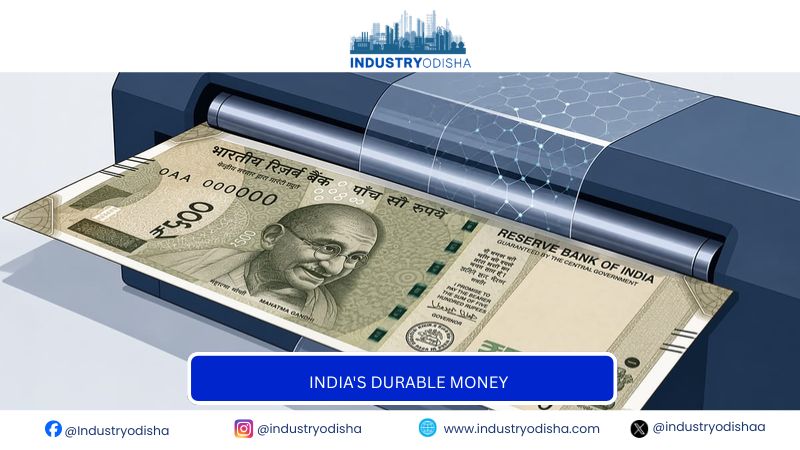
Industry Odisha Bureau, Jul 26: The future of the rupee may be plastic. India’s central bank is testing a technology that dozens of countries have already adopted and that could fundamentally reshape how physical currency circulates in the world’s most cash-dependent large economy.
On July 17, the Bharatiya Reserve Bank Note Mudran Private Limited (BRBNMPL), the Reserve Bank of India’s note-printing subsidiary, issued a global tender seeking manufacturers to supply polymer substrate for Indian banknotes. The move signals serious intent. While field trials remain preliminary and focused initially on lower denominations, the tender represents India’s formal entry into a technological shift that has already transformed currency in countries ranging from Australia to Canada to Brazil.
Polymer banknotes are not ordinary plastic. They are manufactured from Biaxially Oriented Polypropylene (BOPP), a specially engineered substrate designed to withstand the rigours of daily circulation. The difference from cotton-based paper currency is immediate: polymer notes resist moisture, oils, sweat, and grease while maintaining structural integrity far longer than traditional notes. Central bank experience globally demonstrates that polymer notes remain in active circulation two to two-and-a-half times longer than paper alternatives a durability advantage that carries significant economic implications.
For India, this matters acutely. Lower denominations such as ₹10 and ₹20 experience punishing circulation, changing hands constantly and deteriorating visibly within months. These notes are precisely where the Reserve Bank will begin trials, seeking 68,000 reams of BOPP substrate divided equally between the two denominations. The tender explicitly reserves scope for larger procurements following successful field trials, suggesting the central bank anticipates broader adoption if initial tests prove viable.
The economics tip toward polymer over extended timeframes. Although manufacturing costs exceed those of paper notes, the extended lifespan reduces replacement printing demands, transportation expenses, and destruction of worn currency. Across multiple currency cycles, these savings accumulate significantly. The central bank’s calculation appears focused less on immediate cost reduction and more on long-term efficiency gains and operational sustainability.
Counterfeiting presents another compelling motive. Polymer substrates can incorporate security features impossible on paper transparent windows, metallic numerals, holographic elements, magnetic pseudo threads, and iridescent patterns. The BRBNMPL tender specifies several of these features, reflecting security objectives that extend beyond durability.
Importantly, India’s transition toward polymer currency carries no suggestion of disruption to existing cash. Polymer notes are expected to circulate alongside paper currency during any gradual implementation, mirroring how the central bank has managed previous design transitions. No demonetization framework has been proposed or announced. The Reserve Bank appears positioned toward evolutionary change rather than abrupt transformation an approach consistent with India’s deep dependence on physical cash for daily transactions and the operational complexity that rapid currency shifts entail in a system where hundreds of millions remain outside digital payment networks.
Whether trials succeed will determine pace. But India’s formal exploration of polymer technology signals recognition that modernizing banknotes remains central to effective currency management in the 21st century.
