



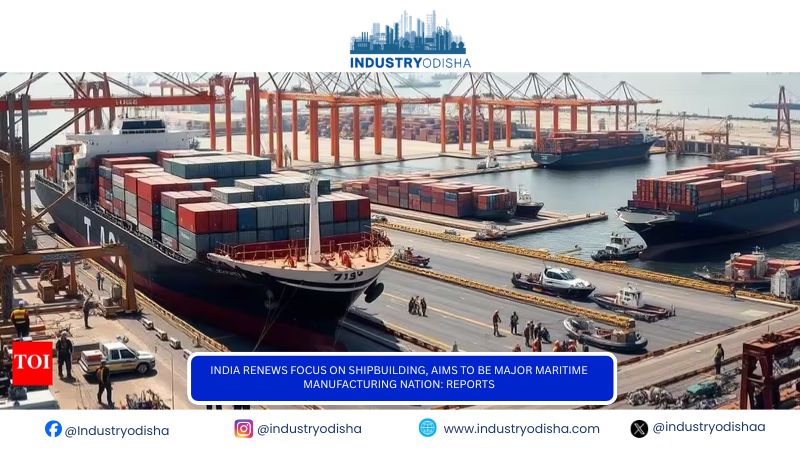
Industry Odisha Bureau, Jul 24: Aiming to become a major maritime manufacturing nation, India has reportedly renewed its focus on shipbuilding so that it could reduce dependence on imported ships as well as make a mark in the global logistics and vessel manufacturing activities.
Media reports quoting experts said that, “While China, South Korea and Japan have been dominating the scene in the global shipbuilding market, India stands at less than one per cent. The renewed focus on shipbuilding by India would obviously support the country’s broader industrial strategy. Besides, this sector has also the scopes for creating high-skilled jobs, support the steel, engineering and electronics industries apart from boosting exports and strengthening maritime security.”
Media reports claimed that, “Indian shipyards like the Cochin Shipyard Ltd (CSL) has secured an order from French shipping giant Compagnie Maritime d’Affrètement (CMA) Compagnie Générale Maritime (CGM) to build six feeder container vessels of around 1,700 TEU capacity, Swan Defence & Heavy Industries has secured orders for six specialized chemical tankers from Norwegian shipping company Rederiet Stenersen, and four Kamsarmax (named after the port of Kamsar in Guinea) bulk carriers from London Stock Exchange-registered New Energy One ACON (NEOA), while Larsen & Toubro Ltd (L&T) have also started participating in commercial shipbuilding tenders covering platform supply vessels, medium-range tankers, container vessels and Very Large Gas Carriers (VLGCs).”
It has also been reported that, “The Government of India has revamped its Shipbuilding Financial Assistance Scheme (SBFAS) in September 2025 following which it has started attracting industry participation.”
It has further been reported that, “The Government of India has earmarked Rs 25,000 crore for financial aid between FY26 and FY36, that includes Rs 20,000 crore Maritime Investment Fund (MIF), which could expand to Rs 30,000 crore with private participation, and Rs 5,000 crore Interest Incentivization Fund (IIF) to reduce borrowing costs for maritime projects.”
