



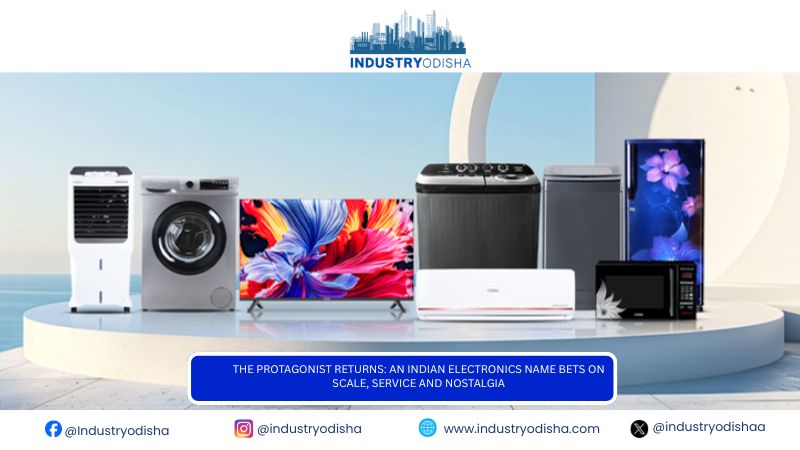
Industry odisha Bureau, Jul 24: Few advertising symbols in Indian consumer memory carry the recall of a horned red mascot that once sold televisions to a liberalising middle class. Three decades later, the company, Onida Electronics, behind it is wagering that the same character — refreshed for a market that now streams more than it broadcasts — can help buy back relevance in one of the world’s most contested electronics markets.
Onida Electronics has kept the mascot and will build a new advertising campaign around it in the months ahead, part of a wider repositioning the company calls “Onida Rewired.” The decision is a calculated one. Brand recall is among the few assets a legacy Indian manufacturer still holds against multinationals that spend far more on marketing, and discarding it would have meant starting from zero in a category where Samsung, LG, Sony, TCL, Hisense and Xiaomi have spent years building shelf presence and consumer trust.
Product first, at the top of the range
The commercial expression of that repositioning arrived with a 100-inch QD Mini LED television — the company’s flagship, and a deliberate entry into the ultra-large-format segment rather than the volume tiers where Chinese and Korean manufacturers compete on price with the advantage of vastly larger procurement scale.
Large-screen demand has been among the more durable trends in Indian consumer electronics, driven by falling panel costs, streaming adoption and a broader premiumisation across durables categories. Screen sizes that were niche a decade ago now anchor mainstream retail displays. For a returning brand, the top end offers thinner competition and better margins, though it also demands credibility that a nostalgic mascot alone cannot supply.
Bringing production back in-house
Behind the product sits a structural decision. Onida operates two of its own manufacturing plants alongside several contract facilities, and intends to exit contractual manufacturing entirely.
That is an unusual direction at a moment when much of the industry has moved the other way, leaning on third-party assemblers to stay asset-light. The reasoning is control: over quality, over development timelines, over the specification decisions that determine whether a premium product is genuinely differentiated or merely priced as though it were. It also aligns with the domestic manufacturing incentives that have reshaped electronics production in India over the past several years.
The eastern wager
Where Onida chooses to compete may matter as much as what it sells. The company has identified eastern India — West Bengal in particular — as the fulcrum of its expansion, with Kolkata at the centre.
The logic is visible in the numbers management cites: in outlets where Onida is already stocked in Bengal, the brand accounts for roughly 2 to 3 percent of sales. That is a modest base, but it is a base, and it sits in a region where competitive saturation is lower than in the western and southern metros that absorb most multinational marketing spend.
Building on it requires distribution reach the company does not yet have. Onida plans to take its retail footprint to about 100 outlets over the next two to three years and to deepen relationships with channel partners — the distributors and dealers who, in Indian durables retail, often determine which brand a walk-in customer is steered toward.
Service as strategy
Perhaps the least glamorous commitment is the most consequential. Onida intends to expand its nationwide after-sales network beyond 400 service partners within twelve months.
Service infrastructure is where smaller manufacturers have historically lost premium buyers. A customer spending heavily on a large-format television is buying an installation, a warranty and a repair response as much as a panel — and multinational rivals have decades of investment in exactly that. Closing the gap in a year is an aggressive schedule.
The arithmetic of ambition
Chief Executive and Managing Director Gunjan Shrivastava has set Onida electronics a target of growing sales five to six times over the next two to three years, alongside entry into several new consumer electronics categories beyond its existing television and air-conditioning lines by 2027–28. He describes the initiative as a step toward a “future-ready consumer technology company,” built on premium innovation and a deeper retail and service footprint.
The candour in his framing is notable: the company was a leading name in the 1980s and 1990s, he acknowledges, and lost visibility in the decades that followed.
Whether it recovers that ground will be decided less by the mascot than by the unglamorous work behind it — plant utilisation, dealer margins, service turnaround times, and a product roadmap that must arrive on schedule in a category where competitors refresh their ranges annually. Heritage brands in India have attempted revivals before, in electronics and elsewhere, with mixed results. The ones that worked paired the nostalgia with something demonstrably better on the shelf.
