



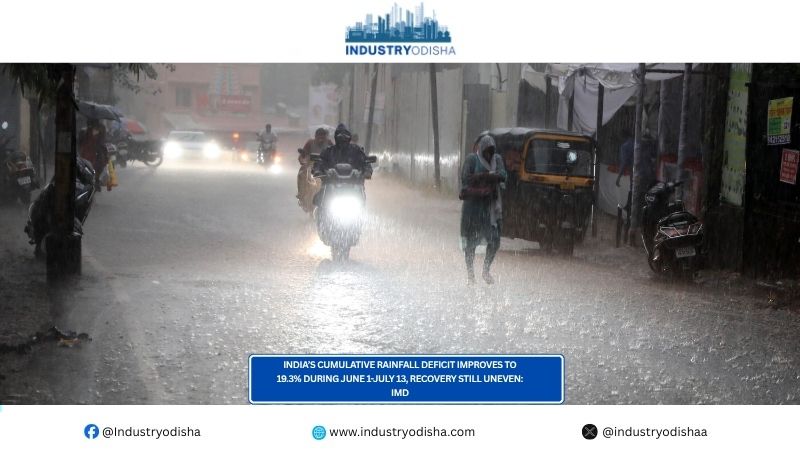
Industry Odisha Bureau, Jul 15: The latest data released by the India Meteorological Department (IMD) reportedly claimed that India’s cumulative rainfall deficit improved to 19.3 per cent during June 1–July 13 from 38 per cent at the end of June, but the rainfall-deficit recovery is still uneven across the country.
So far, the rainfall deficit is concerned, reports claimed that, “the east and north-east India regions remain the worst affected with 35.5 per cent, while the south peninsula’s rainfall deficit stands at 21.5 per cent, north-west India 11.9 per cent, and central India regions with 8.5 per cent.”
Agriculture experts have reportedly opined that, “The month of July is the most crucial period in a monsoon-fed agricultural country like India, because July accounts for around 32 per cent of monsoon rainfall and around 55 per cent of the annual Kharif sowing.”
Contending that “a lingering rainfall deficiency in India during the crucial month of July could adversely affect the agricultural yield”, the agriculture experts also reportedly reasoned out that, “monsoon rainfall during the month of July in India contributes to 65 per cent of pulse sowing, 66 per cent of oilseed sowing, and 62 per cent of coarse cereal sowing.”
As per media reports, “Due to the monsoon rainfall deficiency during this Kharif season, lower acreage of major crops, like paddy, pulses, cotton and oilseeds, is being recorded. Total 53.12 million hectares of area has been planted in this Kharif season as of July 10 in comparison with 63.25 million hectares of Kharif area during the same period last year.”
With food inflation already in an upward trend as being reported, the later half of the ongoing month of July is being observed anxiously since the parentage of this year’s annual monsoon rainfall would be playing a decisive role in determining the nature and volume of harvests, rural incomes, inflation, and above all, the broader economic outlook for the current fiscal year 2026-27 (FY27).
