



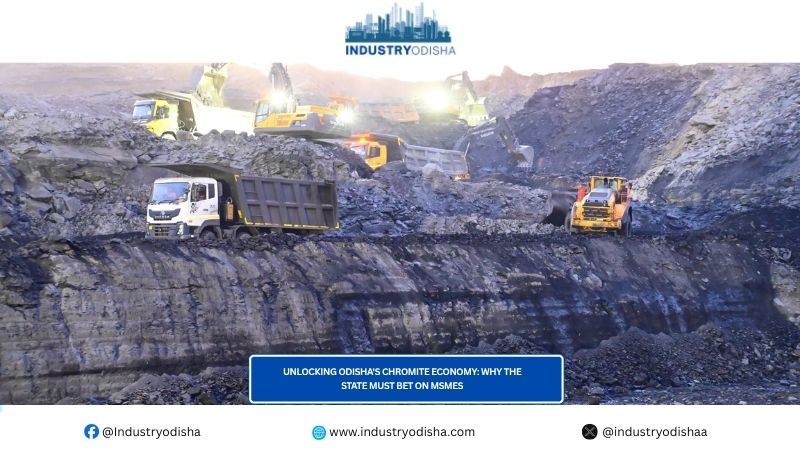
Odisha’s recent push to attract large-scale investments in mining and mineral processing, including approvals for new industrial projects and the government’s emphasis on value-added manufacturing, has reopened an important question: Can the state’s vast chromite reserves become the foundation for an MSME-led manufacturing revolution rather than merely supporting mining and ferrochrome production?
Odisha sits on 96% of India’s chromite resources, making it the undisputed leader in the country’s chromium economy. Most of these deposits are concentrated in the Sukinda Valley of Jajpur district, one of the world’s largest chromite-bearing belts. While India is among the world’s leading producers of chromite, global reserves are largely concentrated in South Africa, Kazakhstan and Zimbabwe.
This gives Odisha a strategic advantage not just nationally but also in the global stainless steel value chain. The state’s challenge is no longer to mine more chromite, but to leverage this near-monopoly to build a thriving ecosystem of MSMEs manufacturing high-value stainless steel and engineering products, thereby creating jobs, boosting exports and generating far greater economic value than the sale of raw ore alone.
Here’s how Odisha’s chromite can power an MSME revolution…
A reliable raw material base
For MSMEs, access to raw materials is often one of the biggest challenges. Odisha’s vast chromite reserves provide a dependable and cost-effective supply of chromium, the key ingredient in stainless steel. Proximity to mines and ferrochrome plants reduces transportation costs, shortens supply chains and makes local enterprises more competitive than manufacturers dependent on imported or distant raw materials.
A thriving downstream manufacturing ecosystem
Chromite is the starting point of a long industrial value chain. Once converted into ferrochrome and stainless steel, it can support thousands of MSMEs manufacturing products such as kitchenware, hospital furniture, food-processing equipment, industrial pipes, fasteners, pumps, valves, railway fittings, construction hardware, agricultural implements, precision engineering components, and architectural fixtures. Instead of exporting raw minerals, Odisha can nurture enterprises that produce finished goods with much higher value addition.
Employment generation
Unlike mining, which is capital-intensive, MSMEs are labour-intensive. Small manufacturing units require welders, machinists, fabricators, electricians, designers, quality inspectors, transporters and maintenance workers. A strong chromite-based MSME ecosystem can generate employment across urban and rural Odisha while creating opportunities for first-generation entrepreneurs and skilled youth.
Supply India’s manufacturing growth
India’s expanding investments in railways, defence, renewable energy, electric vehicles, food processing and urban infrastructure are driving demand for stainless steel products. Odisha’s MSMEs can become suppliers of components, fabricated structures and engineering products to these fast-growing sectors. This integration into national supply chains will provide stable markets and encourage technological upgradation.
Boost exports and competitiveness
Finished stainless steel products fetch significantly higher prices in global markets than raw chromite or ferrochrome. With ports such as Paradip and Dhamra, Odisha enjoys a logistical advantage for exports. MSMEs manufacturing value-added products can access international markets, earn foreign exchange and strengthen the state’s position in global manufacturing.
Industrial clusters and innovation
Dedicated stainless steel parks, common facility centres, testing laboratories and design hubs can enable MSMEs to share infrastructure and reduce production costs. Collaboration with technical institutions will improve product quality, encourage innovation and help enterprises adopt advanced manufacturing technologies. Such clusters also attract ancillary industries, creating a multiplier effect across the local economy.
Odisha’s chromite is more than a mineral reserve; it is a strategic economic asset. The state has already mastered the art of extraction. Its next challenge is to master the art of value creation. Every tonne of chromite converted into stainless steel products by local MSMEs means more jobs, higher incomes, stronger exports and greater revenues than a tonne shipped out as raw ore. If Odisha can build a robust ecosystem of downstream enterprises, it will not merely remain India’s chromite capital, it will emerge as the country’s stainless steel manufacturing hub. The future of the state’s mineral wealth lies not in its mines, but in the thousands of entrepreneurs who can transform it into prosperity.
