



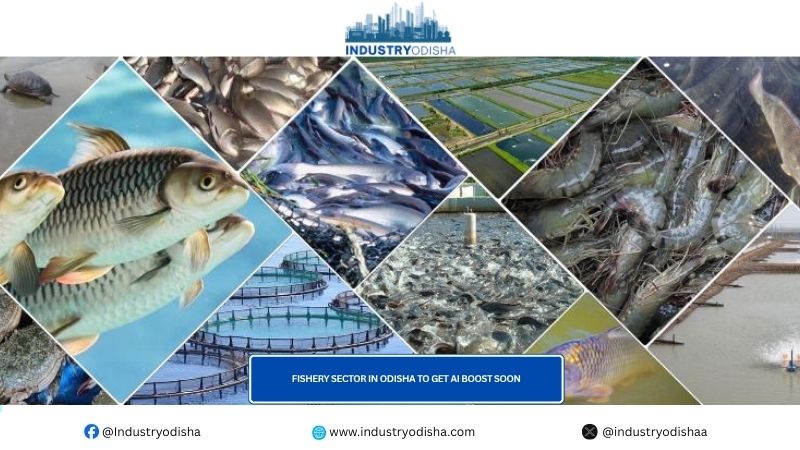
Industry Odisha Bureau, Jun 23: Odisha has emerged as one of India’s leading states in freshwater aquaculture, contributing significantly to fish production and supporting thousands of small and marginal farmers.
Despite this growth, most fish farmers in Odisha still depend on manual observation methods to monitor pond conditions. Factors such as fluctuating temperatures, cyclonic rainfall patterns, prolonged summers, and irregular water exchange practices often lead to rapid deterioration of water quality.
Therefore, the State Government has decided to set up an AI-enabled IoT-based Pond Monitoring and Advisory System to provide real time advice to the farmers and boost their growth.
At present, critical parameters like Dissolved Oxygen (DO), pH balance, and ammonia levels can shift within a matter of hours, creating conditions that lead to fish mortality, reduced growth, or disease outbreaks.
These challenges become more severe during peak summer months and periods of erratic monsoon rainfall, which have historically caused major losses to the aquaculture community, officials said.
“Manual monitoring is not only labor-intensive but also prone to delays, as farmers check pond conditions at irregular intervals. This often results in late detection of hazardous conditions such as oxygen depletion, ammonia accumulation, or pH imbalance,” they said.
The lack of timely, scientific, data-driven insights means that many farmers resort to guesswork when deciding when to run aerators, when to exchange water, how much to feed, or how to respond to changing climatic conditions, the officials said.
As a result, operational inefficiencies persist, leading to unnecessary electricity costs, feed wastage, and preventable stress on fish stocks.
To overcome these long-standing challenges, The Odisha Computer Application Centre (OCAC), in collaboration with the Fisheries and Animal Resources Development Department, and CIFA, has proposed an AI-enabled IoT-based Pond Monitoring and Advisory System.
The initiative is designed to modernize aquaculture practices by offering real-time visibility into pond conditions, predictive insights, and scientifically driven advisories for farmers.
This effort aligns with the State’s objectives of promoting scientific fish farming, improving farmer incomes, reducing resource wastage, and strengthening climate resilience.
The pilot deployment across 400 selected ponds will serve as a proof of concept, creating a scalable framework that can later be expanded statewide to support sustainable fisheries management and enhance the livelihoods of the aquaculture community.
The primary objective of this project is to design, develop, deploy, and operationalize a comprehensive AI-enabled IoT-based system that monitors freshwater fish ponds in real time and assists farmers and officials in managing pond environments proactively.
The system aims to provide continuous measurement of water quality parameters, predictive alerts based on advanced analytics, and AI-driven advisories that help maintain optimal living conditions for fish.
The ultimate goal is to reduce fish mortality, improve growth rates, optimize feeding practices, lower operational costs, and enable the adoption of scientific and climate-resilient aquaculture practices across Odisha.
The objective is to ensure long-term sustainability of the system by equipping field users, farmers, and fisheries officials with the necessary training and resources to operate and support the technology independently.
The project also seeks to bring transparency and efficiency to fisheries management by establishing a centralized digital ecosystem where farm-level data from all 400 selected ponds can be analyzed and monitored in pilot phase (which will be extend further after successful pilot implementation). This will enable district and state-level authorities to receive insights on overall pond health, risk zones, emerging trends, and necessary interventions.
The AI-powered advisory component will help both farmers and administrators make informed decisions, while the inclusion of Odia-based voice interfaces will ensure accessibility for all user groups.
