



It’s official. An advanced Atmospheric Space Research Facility (ASRF) will be established in Balasore, Odisha. This was announced by Pratap Charan Sarangi, MP, Balasore, in an interaction with media recently. A defence land worth 19.25 acres of has been officially leased to the Indian Space Research Organisation (ISRO), he informed.
The decision to establish an ASRF in Balasore marks a defining moment in Odisha’s scientific journey. While the state has long been associated with mineral wealth, industrial growth and strategic defence infrastructure, this new initiative signals a shift towards a knowledge-driven future powered by research, innovation and technological excellence, feel experts.
The upcoming facility is expected to support research related to the atmosphere, space environment and satellite-based studies.
If reports are to go by, the roots of the Advanced Atmospheric and Space Research Facility (ASRF) stretch back to 2021, when the India Meteorological Department, ISRO, DRDO, and the Ministry of Earth Sciences proposed setting up India’s first Thunderstorm Research Testbed in Balasore. The objective was clear: to better understand the severe thunderstorms, lightning strikes, and extreme weather phenomena that routinely affect eastern India.
What began as a specialised weather-research initiative gradually evolved into a far more ambitious vision—an integrated centre for atmospheric and space science research.
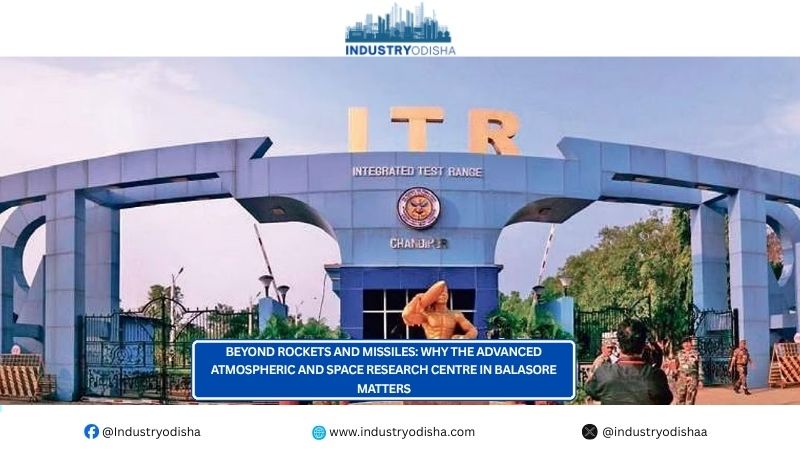
Balasore was chosen for the ASRF because it combines a unique scientific environment with strong research infrastructure. Situated along the Bay of Bengal, it is highly vulnerable to cyclones, thunderstorms, lightning, and other extreme weather events, making it an ideal natural laboratory for atmospheric studies. The presence of Chandipur’s Integrated Test Range and decades of aerospace and defence research further strengthen its suitability.
Why it is significant
Strengthens India’s space and atmospheric research ecosystem
As atmospheric and space science are among ISRO’s priority research areas, the centre will function as a “super site” for studying the Earth’s atmosphere and near-space environment, which is critical for satellite operations, communication systems, navigation, and future space missions.
Enhances weather and disaster forecasting
More importantly, it can improve forecasting accuracy, early warning systems, and disaster preparedness, helping save lives and reduce economic losses, especially for a state like Odisha, which is highly vulnerable to cyclones, thunderstorms, lightning strikes, and extreme weather events.
Boosts Scientific Talent and Innovation
Similarly, experts are of the view that the facility will attract scientists, researchers, startup and academic collaborations by creating opportunities for students from Odisha’s universities to engage in cutting-edge research in meteorology, climate science, remote sensing and space technology.
Supports Climate Change Research
For a coastal state like Odisha, which is vulnerable to climate change and extreme weather events, the facility can facilitate and generate valuable data for climate modelling, coastal management, agriculture planning and water resource management.
In other words, ASRF can become a major catalyst for Odisha’s knowledge economy. Beyond advancing scientific research, it is expected to attract investment, generate high-skilled jobs, encourage collaborations with universities and create opportunities for startups in space technology, climate services, remote sensing and data analytics. Improved weather forecasting and disaster prediction can reduce economic losses from cyclones and extreme weather, protecting agriculture, fisheries and infrastructure. The facility will also enhance Odisha’s reputation as a hub for science and innovation, attracting talent, research funding, and future technology-driven industries.
Having said that, its success will depend on overcoming several challenges. The first is ensuring sustained funding and institutional support, as world-class research centres require long-term investment beyond the construction phase. Attracting and retaining top scientific talent in a non-metropolitan location could also prove difficult. Strong collaboration between ISRO, DRDO, the Ministry of Earth Sciences, universities and industry will be essential to maximize research outcomes. Odisha must also develop a broader innovation ecosystem, including skilled manpower, startups and industry partnerships to translate scientific research into economic gains. Without such integration, the facility risks remaining a standalone institution rather than becoming a driver of regional development and technological innovation.
