



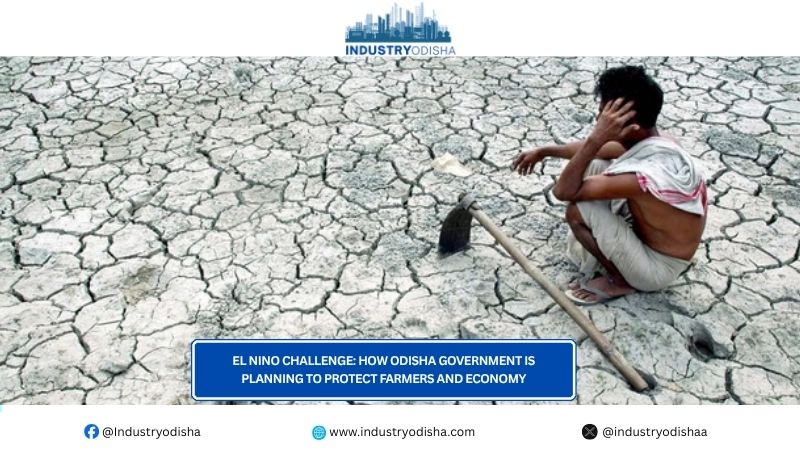
As India Meteorological Department predicts a below-normal monsoon and a possible El Niño effect for Odisha— to receive below-normal rainfall during the monsoon season from June-September this year— the state government has proactively shifted from a reactive crisis-response model to an extensive climate-resilience strategy.
El Nino is a phenomenon, which is characterised by the warming of sea surface temperatures in the Pacific Ocean, often leading to below-normal monsoon rainfall in India.
It results in drought-like conditions, lower crop yields and stress on water resources. For Odisha, where agriculture supports nearly half the population and remains heavily dependent on the monsoon, the stakes are particularly high.
However, drawing lessons from its globally acclaimed disaster-management model, the state has adopted a proactive strategy to counter the possible impact of El Nino in 2026. Instead of reacting after crop losses occur, the government is focusing on preparedness, resilience and risk mitigation.
Led by Deputy Chief Minister and Agriculture Minister Kanak Vardhan Singh Deo, the state has rolled out a comprehensive contingency roadmap focused on safeguarding farmers and securing the state’s agricultural output.
Let’s look at the state’s preparedness towards countering deficit rainfall:
Climate-resilient seeds and contingency planning
In a bid to offer respite to the farmers, the government has prioritised the distribution of drought-resistant seeds. Government is making sure that farmers get special varieties of seeds that need less water and can grow faster before the Kharif sowing season begins. These seeds are better suited for situations where rainfall is delayed or below normal because of El Nino. Even if the monsoon is weak, these crops have a better chance of surviving and producing a good harvest, helping farmers reduce losses and protect their incomes.
The government has also maintained seed reserves and prepared district-specific contingency plans to ensure that farmers can switch crops if rainfall patterns become unfavourable.
Promoting crop diversification
It’s a known fact that paddy has been the backbone of Odisha’s agricultural economy, occupying the largest share of the state’s cultivated land and supporting millions of farming households. Rice is not only the state’s staple food but also a major source of rural income. However, excessive dependence on a single crop comes with significant risks, especially during years of erratic rainfall and drought.
Since paddy is a water-intensive crop that requires adequate and timely monsoon rains for healthy growth, farmers face lower yields, crop failures and income losses when rainfall is deficient—as is often the case during El Niño years. If a large majority of farmers cultivate only paddy, a poor monsoon can affect entire regions simultaneously, putting pressure on food production, rural livelihoods and the state’s economy.
Keeping these things in mind, the state government has created awareness campaigns, and is encouraging farmers to grow millets, pulses, oilseeds and other less water-intensive crops, which can reduce dependence on rainfall, spread risk and provide alternative sources of income. These crops are generally more resilient to drought conditions, require fewer inputs, and can improve soil health.
Moreover, the state has planned a community nursery approach to raise paddy seedlings centrally, allowing farmers to transplant them rapidly once water becomes available.
Expanding crop insurance protection
The government has also heavily intensified enrolment under the Pradhan Mantri Fasal Bima Yojana (PMFBY) to insulate farmers from financial ruin caused by potential dry spells. Under this initiative, small and marginal farmers owning up to two hectares of land do not have to pay the insurance premium, as the state government covers the entire cost. Farmers only need to pay a token fee of ₹1 to enroll. This ensures that if crops are damaged due to poor rainfall or other natural calamities, farmers receive financial compensation and are protected from severe economic hardship.
Leveraging technology and weather intelligence
Most importantly, it is relying on scientific forecasting and digital advisories. Through collaboration with the India Meteorological Department (IMD), Odisha University of Agriculture and Technology (OUAT) and Krishi Vigyan Kendras, farmers are receiving real-time information on weather conditions, pest outbreaks and crop management practices.
Such advisories enable farmers to make informed decisions regarding sowing, irrigation and harvesting.
In agriculture, information is often as valuable as water, and timely forecasts can significantly reduce losses.
By investing in preparedness, resilience and climate-smart agriculture, the state is ensuring that a weak monsoon does not become a rural crisis tomorrow. In an era of growing climate uncertainty, such foresight is not just good governance, it is a necessity.
