


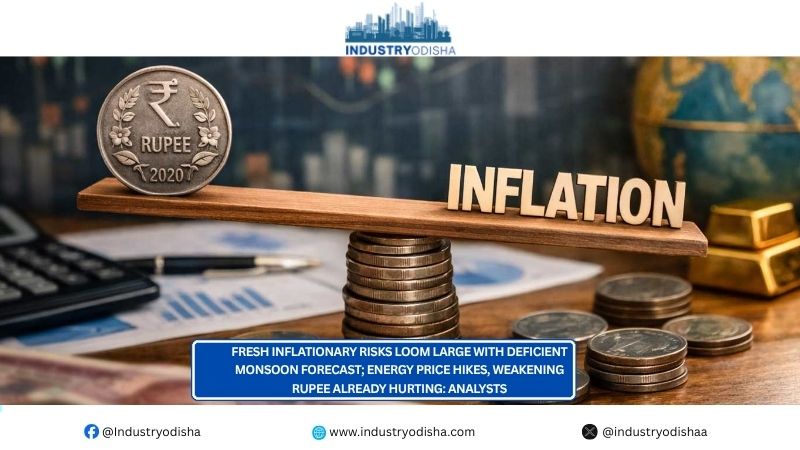
Industry Odisha Bureau, June 1: Despite the Finance Ministry’s reported reiteration claiming that India’s economy remains resilient and fundamentally strong, the forecast of a deficient monsoon (below-normal rainfall) this year predicted by the India Meteorgical Department (IMD) has made one and all more apprehensive of fresh inflationary risks in sequel to the soaring energy prices and a weakening Indian currency (Rupee) already in place triggering inflationary pressures.
Analysts are of the view that the next few months would critically determine the fate of India’s inflationary scenario. Basing on the proportion of rainfall in the ensuing monsoon season as well as the developments in the global oil markets, it is being anxiously waited and watched if India’s inflationary position would be under control or beyond control.
While India’s Finance Ministry has reportedly warned that “external shocks are creating significant headwinds” (circumstances or factors inhibiting progress), the Department of Economic Affairs has also reportedly stated in its May economic review that “confluence of elevated global energy prices, a depreciating rupee, rising upstream cost pressures and the prospect of a below-normal monsoon calls for sustained policy vigilance.”
Since India reportedly imports over 80% of its crude oil demands, the disruptions of supply chain at the Iran-imposed blockade of critical chokepoint Strait of Hormuz since February 28 this year has already made petrol, diesel and LPG expensive along with increased costs in transportation, logistics and manufacturing. The consumers are now bearing the brunt.
Moreover, the depreciation of rupee (Rs 97/$ during May) is adding fuel to the fire as a weaker rupee is making India’s imports of crude oil, edible oils, fertilizers and industrial raw materials more expensive, and India’s imported inflation could worsen further, as observed by the analysts.
The analysts have also observed that a deficient monsoon being predicted by the IMD could drastically reduce harvest, rural income to be hurt, weaken rural consumption demand, and also hike the food inflation that is one of the biggest risks lurking in the face of India’s populace and economy.
Apart from this, the Finance Ministry has reportedly highlighted “the sharp rise of 8.3% in the Wholesale Price Index (WPI) inflation in April 2026, while the WPI inflation in March stood at 3.88%.”
Thus, analysts have reportedly concluded that: “The retail inflation would be higher in the ensuing months due to higher input costs being suffered by the manufacturers resulting in the burden of higher costs obviously to be shouldered by the consumers ultimately.”
