


Industry Odisha Bureau, Jul 29: Across corporate America, a quiet realignment is underway. When boards face existential moments whether reputational crisis, operational challenge or investor uncertainty they increasingly turn to a familiar playbook: recruit a seasoned executive pulled from the sidelines.
The pattern has become so pronounced that industry watchers debate whether true retirement exists for chief executives at all. After stepping down, many transition seamlessly into board positions, advisory roles and consulting work. The next logical step, when circumstances align, is simply returning to the corner office.
This dynamic reshapes how major corporations approach succession planning, particularly during turbulent periods. Companies like Boeing, Verizon and Cracker Barrel have all made this calculation recently, prioritizing immediate credibility and operational continuity over grooming internal talent or betting on younger external candidates.
“In this country, CEOs don’t really retire, they just become professional directors,” noted Matteo Tonello, head of data benchmarking and analytics at the Conference Board. Some eventually leave board work and move back into the top job.
The appeal cuts both directions. For boards, an experienced executive provides instant institutional legitimacy. For executives living comfortably in retirement one newly hired Verizon CEO had been riding horses daily on a Montana ranch a return to leadership offers intellectual stimulation and restored influence.
Yet the evidence on performance remains ambiguous. Research by Spencer Stuart found that while most first-time CEOs outperform their markets, only 40 percent manage the same feat in a second CEO role. The challenges remain formidable regardless of prior experience.
Boeing extended its mandatory retirement age when appointing Kelly Ortberg, 64, to its top job in 2024. Ortberg had spent years leading a major aerospace supplier before retiring in 2021, remaining on a corporate board until his recall.
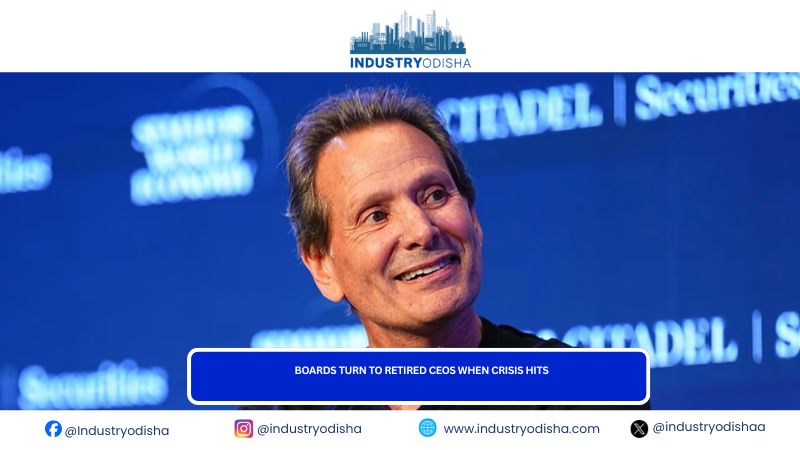
Dan Schulman, 68, similarly traded his ranch life for Verizon’s leadership after years on the company’s board. He had observed the company “at an inflection point,” he explained, with capacity to transform.
Cracker Barrel’s recent appointment of David Deno reflects a particular moment: the family-dining chain attempted a modernization that backfired spectacularly. Consumer backlash over rebranding efforts forced a reversal. The board, seeking to stabilize investor confidence, recruited Deno from his post-retirement board positions at Krispy Kreme and Panera Brands. Previously, he had led Bloomin’ Brands, where he notably protected employment during the pandemic downturn.
Governance expert Jo-Ellen Pozner notes that boards often overlook a crucial distinction: some retired executives remain deeply engaged through continuous board service, while others simply seek escape from boredom and irrelevance. Both groups may return to leadership, but with vastly different preparation levels.
“There’s a limited pool of candidates who carry both industry expertise and Wall Street trust,” Tonello observed. That scarcity reshapes boardroom calculations about age, experience and readiness in ways that internal succession planning simply cannot resolve.
