



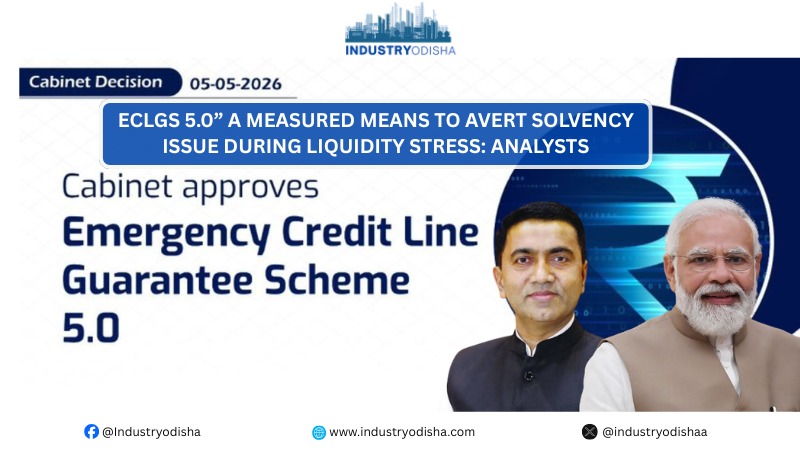
Industry Odisha Bureau, May 7: In the wake of India’s Union Cabinet having reportedly allocated Rs 18,100 crore on May 5 under the fifth edition of the Emergency Credit Line Guarantee Scheme (ECLGS 5.0), analysts reportedly term it as a well-calibrated initiative to pre-empt solvency issue during the liquidity stress triggered by the ongoing West Asia crisis as well as inits aftermath.
Analysts reportedly deem that the “ECLGS 5.0 would provide the lenders (banks) a measured means to keep credit flowing without exposing themselves to disproportionate risks since they are already well-capitalised”.
As per media reports, such a move by the Government of India (GoI) has been undertaken when the geopolitical uncertainties and risks sparked off by the West Asia conflict are lurking in the faces of trade flows, volatile energy prices and export-oriented sectors.
While the initiative is said to be akin to the one taken earlier during the unprecedented pandemic (Covid-19)-induced lockdown and its repercussions, the ECLGS during Covid-19 is being argued to have “addressed a domestic demand collapse, while ECLGS 5.0 is designed to counter an external shock in shape of supply chain disruption and input costs rather than a lockdown-driven demand slump”.
As per media reports, “ECLGS was first introduced during the Covid-19 pandemic period, while the scheme acted as a liquidity lifeline for small businesses and the broader financial system”.
According to a fresh research made by Macquarie Insights, “SBI economists indicated that approximately 12% of outstanding MSME credit was saved from slipping into NPA (non-performing asset) status specifically due to the ECLGS buffer”.
The research by Macquarie Insights has also found out, “ECLGS saved an estimated 1.46 million MSMEs and protecting around 15 million jobs as it facilitated ₹3.61 trillion in guarantees and ₹2.82 trillion in disbursements between 2020 and 2023”.
Notably, “A solvency issue occurs when a company or individual cannot meet long-term financial obligations because total liabilities exceed assets. It signifies structural financial distress, often stemming from weak earnings or bad assets, unlike temporary liquidity shortages. Key indicators include high debt-to-equity ratios and poor cash flow”.
