



In a move that could boost Odisha’s healthcare sector, Max Healthcare Institute Ltd, one of the prestigious and largest health care units of the country, forayed into Bhubaneswar recently by acquiring 58.4% stake in Bhubaneswar’s Kalinga Hospital for ₹300 crore.
The recent acquisition, which reflects a changing scenario, is even more important because eastern India has always remained at a structural disadvantage— its patients were often compelled to travel to metros like Chennai or Hyderabad for advanced care.
The acquisition, therefore, reflects how in less than three decades, Bhubaneswar has undergone a quiet transformation—from a city with limited medical facilities to a magnet for patients across eastern India. It is emerging as a critical healthcare anchor for the region, signalling a broader shift in India’s medical landscape—from centralised excellence to distributed access.
So, why has Bhubaneswar emerged as the hub of healthcare in the eastern region?
Infrastructure
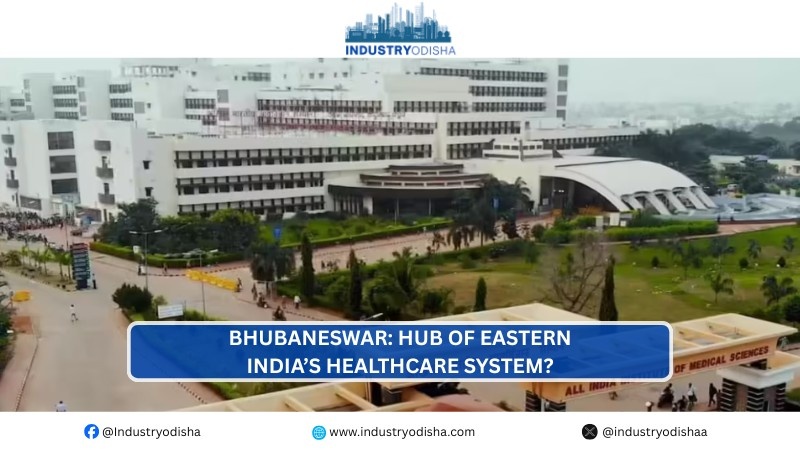
The rapid expansion of healthcare infrastructure is one of the major drivers. From private hospitals to specialized centres, the city now hosts a dense network of public institutions. Flagship establishments such as AIIMS, Bhubaneswar, have anchored tertiary care, while a proliferation of multi-specialty hospitals has filled critical gaps in diagnostics and advanced treatment. Over the past two decades, Bhubaneswar has moved from basic care to offering complex procedures in cardiology, oncology, neurology, and transplant sciences.
This has resulted in the surge of patients both inward and outward. While it has reduced the outflow of patients to Kolkata, Chennai, Hyderabad or New Delhi for specialized treatment, it has also attracted patients from neighbouring states to come here for their treatment.
Corporate Consolidation
Similarly, the establishment of major industries in the city has given confidence to major players in the health sector to invest big in the state capital. The recent ₹300 crore acquisition of Kalinga Hospital by Max Healthcare is a case in point. Corporate players are not just entering, they are scaling existing facilities, upgrading technology and standardising clinical protocols.
This trend mirrors a broader national pattern: instead of building new hospitals from scratch, large chains are integrating regional institutions to accelerate expansion. This in turn has benefited Bhubaneswar as it already possesses established base.
Policy push and public health architecture
Moreover, the state government’s sustained focus on healthcare has also created an enabling ecosystem. By expanding public infrastructure, strengthening district-to-tertiary referral systems and investing in institutions like All India Institute of Medical Sciences, Bhubaneswar, the state has created a strong backbone. While public-private partnerships have attracted players, schemes ensuring free diagnostics and insurance have boosted demand. Simultaneously, focus on medical education has built a steady talent pipeline. Institutions like PGIMER and Capital Hospital and training centres across the city reflect a conscious policy push to address doctor shortages and build specialist capacity.
Affordability
More important, unlike metros such as Delhi or Mumbai, Bhubaneswar offers relatively lower treatment and living costs. This cost advantage, combined with improving quality, is making it attractive not just for domestic patients but also for medical tourism within South Asia.
Bhubaneswar’s rise is not a coincidence—it is the outcome of policy meeting purpose. What Bhubaneswar represents today is more than a healthcare hub; it is a blueprint for decentralising India’s medical access. By aligning public investment, private participation and regional demand, Odisha has shown that quality care need not remain confined to metros. The challenge now is scale with equity—ensuring this growth reaches beyond the capital. If sustained with vision and balance, Bhubaneswar will not just serve eastern India; it will redefine how states build resilient, inclusive, and future-ready healthcare systems.
Investments in medical colleges, free treatment schemes and specialised centres, particularly in cancer care, have strengthened the public health backbone. The push to position the state as a cancer-care hub underscores a strategic shift toward niche excellence.
Simultaneously, institutions like the Regional Medical Research Centre are integrating research, data, and policy, linking Bhubaneswar to global health networks.
Also Read :- “Tata 1mg” Focused On Spreading Wings In India’s Digital Healthcare
