



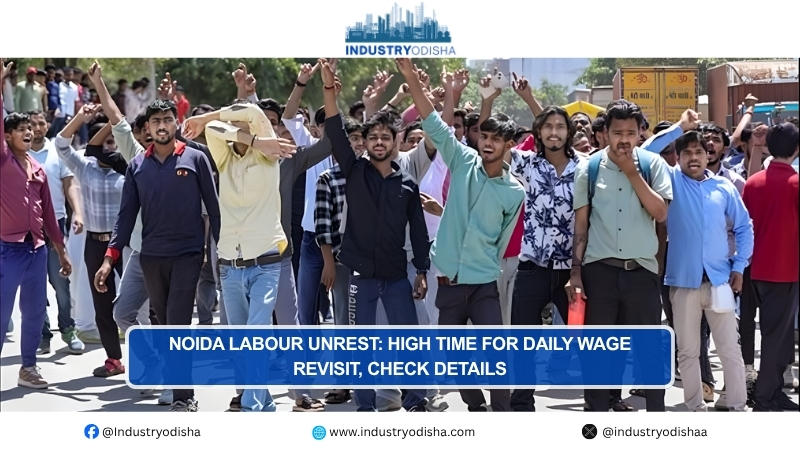
Industry Odisha Bureau, April 17: Despite the much-hyped “Four Labour Codes” introduced last year by the BJP-led NDA Government at the Centre in a bid to streamline wages and labour regulations, the recent labour unrest in Noida in a massive manner (that also reportedly turned violent) has been an eye-opener as well as it is high time for self-introspection by all the state governments across India to implement rational monthly pay-checks and create conducive working conditions in true letter and spirit.
Reports said that the Union Labour Ministry is now exploring ways and means to fix daily minimum wages for all categories of workers (unskilled/skilled/semiskilled).
Experts opine that the onus lies on the Union Government for laying a national floor so that it would be mandatory upon the State Governments across the country to implement it earnestly and they would be deterred from setting their respective daily wages below the national figure(s).
Notably, “The floor wage is a single baseline fixed by the Centre, and applies to all categories such as skilled, semi-skilled and unskilled under the Code on Wages, 2019”, highlighted the experts.
Sources said that, process is on by the Centre to finalize the much-needed “floor wage” by holding discussions with the State Governments, industrial houses and other stakeholders.
Need to be mentioned here that the current “national floor wage of 7176 was set in 2017”.
It has been reported that there is a yawning gap between real wages being paid and the profits earned by the corporates.
In this context, the Economic Survey 2024-25 noted that despite Indian companies maintaining a stable EBITDA margin of around 22% over the past four years, wage growth has moderated.
Let’s elucidate:“EBITDA stands for Earnings Before Interest, Taxes, Depreciation, and Amortization. It is a financial metric used to evaluate a company’s core operating profitability by excluding non-operating expenses (interest, taxes) and non-cash expenses (depreciation, amortization). The EBITDA margin is a profitability ratio measuring a company’s operating cash flow efficiency relative to revenue, calculated as (EBITDA / Total Revenue) × 100. It excludes non-operating expenses (interest, taxes) and non-cash items (depreciation, amortization), making it ideal for comparing core profitability across similar firms”.
Citing the statutory instances, experts underlined, “The Code of Wages-2019 provides for a national floor wage and uniform wage definition, while the Industrial Relations Code, 2020 focuses on dispute resolution and hiring flexibility. The Code on Social Security, 2020 expands benefits to more workers, and the Occupational Safety, Health and Working Conditions Code, 2020 aims to improve workplace conditions.”
It has also been reported that the minimum wages widely vary across the Indian states, while reports further stated: “Karnataka, Maharashtra and Tamil Nadu have higher wages than the national floor, with unskilled workers earning Rs 715,000-16,000 per month. Gujarat offers moderate wages of about Rs 12,700-713,000, while Bihar and Punjab remain on the lower side”.
Thus, various elected public representatives, political parties and trade unions have been laying stress on a “regular and inflation-linked wage revisions to ensure better income security for workers”.
They are of the views that the Government should regularly review and update wages (at least annually) as reportedly done by states like Taml Nadu, Karnataka, et al, in accordance with the cost of living/price hikes. By doing so religiously, such an exercise by the State Governments could avert the labourers/daily wagers not to be left in the lurch and fend for themselves at the time of distress that triggers unrest.
Experts conclude that the better the timely revision of wages and rational pay-checks, the better goes the livelihood of the workers.
To sum up, it would be wise to quote here appliance maker Wonderchef CEO Ravi Saxena: “If India has to build quality, the rise in wages of about 10 to 15% is not likely to have a significant impact on the final cost of the product, as labour is a small part of the overall cost”.
This may lure better talent into the labour pool in India, quipped experts in labour management.
