



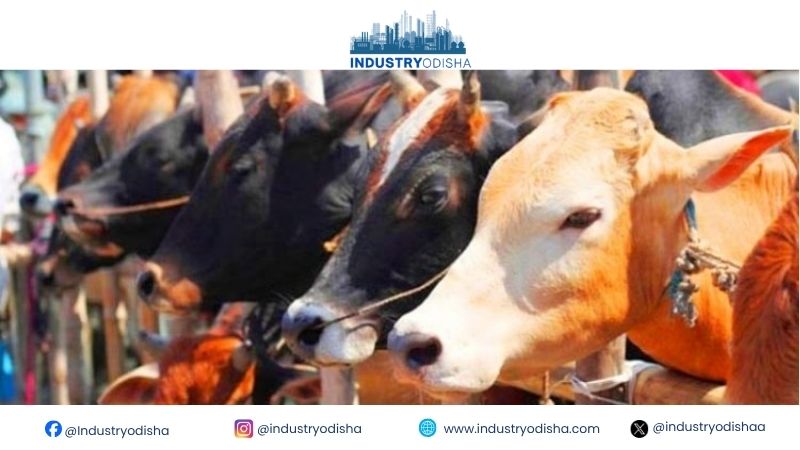
Industry Odisha Bureau, Oct 03: More than 36 crore animals now carry a digital identity. For the first time, insurance rules put a price and loss record against them. Banks are still missing from the picture.
A bank lends against what it can see, value and track. A car has a chassis number. A house has a sale deed. Farm animals had neither, despite their central place in India’s rural economy.
The last census counted 53.7 crore livestock animals. They earn daily income for crores of households. Yet formal finance could not tell one cow from another.
A Number for Every Animal
Under the National Digital Livestock Mission, animals receive a 12-digit bar-coded ear tag. The department calls this identity Pashu Aadhaar. By January 2026, more than 36 crore animals were registered on Bharat Pashudhan.
Against each number, the database records the owner, vaccinations, inseminations and treatments. But a number is not a price. An ear tag alone is not collateral.
A Rupee Value, for the First Time
Livestock valuation enters through the government’s livestock insurance rules. Cows get ₹3,000 per litre of daily milk, or the declared local price. Buffaloes are valued at ₹4,000 a litre. So a cow giving 10 litres daily is worth at least ₹30,000 on paper.
These are insurance benchmarks, not freely traded market prices. For a yak, camel or mithun, owner and insurer negotiate a value before a vet. Disputes go to the Gram Panchayat or the Block Development Officer. Identity can be standardised easily. Economic value cannot.
Insurance Leaves a Paper Trail
The cattle insurance process builds a file around each tag. A vet registered with the Veterinary Council of India examines the animal first. The proposal needs two photographs: one with the owner, one showing the tag.
When the animal dies, the same vet conducts the post-mortem. A claim needs just four documents, including the post-mortem report. Tagged animals are not re-tagged; the existing 12-digit ID is reused. One number can thus carry health, value and loss data together.
Small, and Mostly State-Funded
At the portal’s September 28 launch, 30 lakh-plus animals were insured during the year. That is under 1% of tagged livestock.
Premiums are capped at 4.5% of insured value for one-year policies. The ceiling rises to 5.5% in the North-East and hill regions. Owners pay just 15% of the premium. Governments cover the other 85%.
On a ₹1 lakh animal, the owner pays ₹675 and governments ₹3,825. This is welfare shaped like insurance, not a priced risk market.
Where the Bank Fits In
The Kisan Credit Card has covered animal husbandry since 2019. But KCC applications do not pass through Bharat Pashudhan, the government says. The lender’s system and the animal’s identity system remain separate.
A bank still must judge ownership, value, mortality risk and repayment capacity. Animals also fall sick, die, lose yield or get sold informally. A digital record reduces information gaps. It does not remove biological risk.
Three Tests Ahead
Three questions will decide whether this becomes livestock finance. Will insurance values and claims sit on the same tag record? Will banks ever use that record for agricultural lending? And will insurers price mortality from real loss data, not tender ceilings?
None has happened yet. Identity, value and loss now point at one number on one ear. The missing piece is rural credit. Until banks read that number, the animal remains visible but unbanked.
