



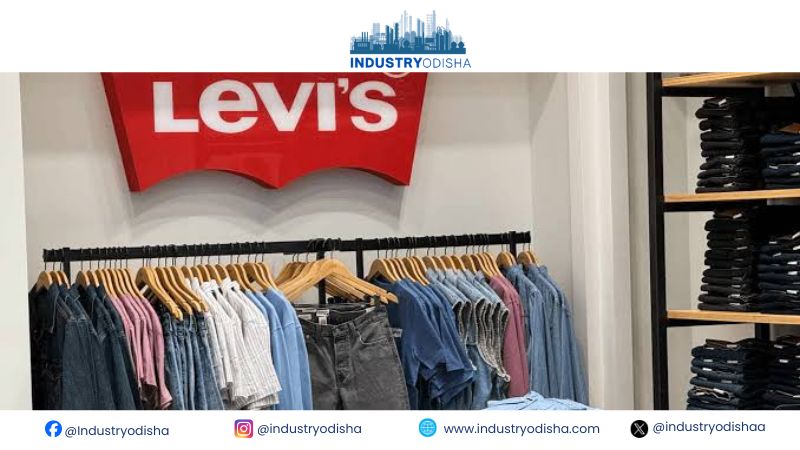
Industry Odisha Bureau, Aug 23: Levi Strauss & Co. is broadening its India business beyond its traditional denim foundation substantially. The California-based apparel maker sees significant opportunities in women’s apparel and non-denim categories. Premium products are emerging as a distinct growth driver across the Indian market landscape. Revenue at Levi Strauss India increased 20.6% to ₹2,223.4 crore in fiscal 2025. Net profit grew 26.9% to ₹202.3 crore, demonstrating operational strength amid broader consumer pressures. The company entered India in 1995 when jeans represented a largely nascent category domestically.
Three decades later, the Indian jeans market is estimated at ₹32,900 crore in 2025. However, Levi’s management recognises that jeans alone cannot drive sustained long-term growth indefinitely. Women’s apparel is growing at a high-double-digit rate compared with mid-double-digit growth in denim. The company’s expanding wardrobe strategy reflects a calculated response to evolving Indian consumer preferences increasingly. India’s consumers are purchasing more tops relative to bottoms compared with global patterns. Domestically, India sells more than one top for every bottom purchased annually. Globally, that ratio stands at approximately one top for every three bottoms purchased. This disparity suggests meaningful room exists for Levi’s to broaden product penetration strategically.
Levi Strauss India’s non-denim extension encompasses linen, basic tops and alternative bottoms. The company views non-denim bottoms as a natural expansion from its core denim franchise currently. Varied fabrics and multiple usage occasions create portfolio space beyond traditional denim alone. Managing Director Hiren Gor highlighted that Indian consumers show “structural upward mobility” increasingly evident. Consumers seek better products, higher quality and enhanced service across their apparel purchases. This premiumisation trend manifests in multiple ways across Levi’s India portfolio strategically positioned. Red Loop, a premium casual-lifestyle extension created specifically for India, now accounts for approximately 15% of business. The brand targets consumers willing to pay more for quality and lifestyle positioning.
Women’s apparel remains central to Levi’s expanded India growth strategy going forward operationally. The category is demonstrating faster growth momentum compared with traditional bottom-oriented business models. Coupled with non-denim diversification, women’s apparel could become increasingly important to revenue generation. Levi’s competes within an increasingly crowded Indian denim and apparel market presently. Established international brands such as Pepe Jeans, Wrangler and Flying Machine retain significant market presence. Newer digital-first competitors including Snitch and Freakins have attracted younger, price-conscious Indian consumers specifically. Despite intensifying competition, Levi’s continues observing sustained demand for premium blue denim globally. Baggy fits and classic styles have returned to prominence in Indian consumer preferences notably.
Levi’s physical retail strategy is undergoing substantial evolution to maximise shopping experiences better. The company is concentrating on larger Icon stores exceeding 5,000 square feet in size. These stores occupy strategic locations offering wider product assortments across genders and multiple fit preferences. The company emphasises comprehensive shopping experience quality rather than simply maximising store count indefinitely. Levi’s has reached approximately 500 stores across India, representing substantial footprint expansion historically. Direct-to-consumer revenue from Icon stores comprises roughly one-fifth of the company’s total revenues currently. The strategic focus suggests Levi’s is pursuing productivity gains rather than aggressive unit expansion.
Local manufacturing provides Levi Strauss India with distinctive competitive advantages increasingly important operationally. More than 95% of products consumed in India are made or built domestically through partnerships. This localised supply chain approach enabled Levi’s to navigate recent global supply disruptions effectively. When West Asia-related conflicts increased fuel and freight costs, Levi’s remained relatively insulated successfully. Proximity to suppliers allows the company to respond rapidly to local demand changes. Supply-chain resilience became particularly valuable when other apparel companies faced substantial disruptions previously uncontemplated.
India’s consumer economy faced meaningful pressure from higher input costs and tighter discretionary spending recently. Apparel companies confronted a two-sided squeeze: elevated operating costs alongside potentially weaker consumer spending simultaneously. Levi’s financial results suggest that branded and premium consumption continues despite broader economic headwinds. The company’s strategic positioning appeals to upwardly mobile consumers prioritising quality and brand affiliation specifically.
Levi’s entered the kidswear segment through a December 2025 partnership with Apparel Group India strategically. The first exclusive Levi’s Kids store opened in Hyderabad during January 2026 recently thereafter. Rather than organic expansion, the company prioritised partnership to preserve focus on faster-growing categories. Men’s bottoms, men’s tops and corresponding women’s categories represent stronger near-term growth potential evidently.
India represents one of Levi Strauss & Co.’s top six global markets strategically important. Management expects India to play a pivotal role in achieving the company’s $10 billion revenue ambition. The country’s expanding middle class and rising consumer aspirations create compelling long-term growth opportunities. Levi’s wardrobe-expansion strategy positions the company to capture more consumer spending beyond traditional jeans categories.
