



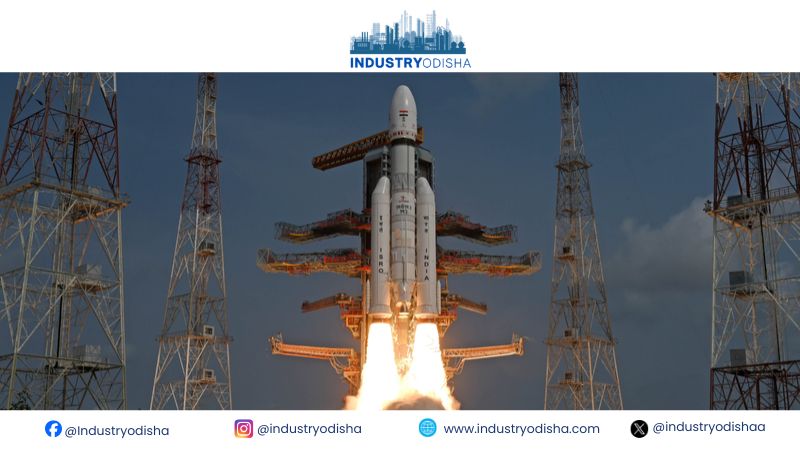
Industry Odisha Bureau, Aug 21: India’s satellite launch costs exceed those of major global competitors by significant margins. A peer-reviewed economics study found India’s reported cost at $13,302 per kilogram. The United States, by comparison, was lowest at just $3,225 per kilogram. This price gap becomes more acute as India’s private space industry continues expanding. The cost differential raises questions about India’s commercial competitiveness in satellite launches.
Among six major markets studied, India ranked most expensive for orbital satellite launches. European Union followed at $9,897 per kilogram, with Russia next at $6,682. China reported costs of $5,809 per kilogram, while Japan’s figure stood at $5,287. India’s position appears counterintuitive given its historical reputation for frugal space missions. This apparent paradox reflects an important distinction in aerospace economics and mission planning.
Scientific missions pursued independently can achieve remarkable frugality in overall budget and expense. However, commercial launch pricing operates under fundamentally different economic and competitive pressures today. A mission’s overall frugality does not automatically translate to lower launch costs per kilogram. India’s fledgling private space industry must navigate these distinct economic landscapes successfully moving forward.
India’s first private commercial rocket launch occurred in July when Skyroot Aerospace succeeded. The company launched its Vikram-1 rocket, marking a milestone for India’s emerging commercial space sector. Skyroot expects at least $4 million in revenue from each Vikram-1 launch operation. With maximum payload capacity of 350 kilograms, the cost averages approximately $11,000 per kilogram.
However, Vikram-1’s capabilities differ markedly from SpaceX’s Falcon 9 reusable orbital rocket system. Falcon 9 can deliver up to 22,800 kilograms to low-earth orbit in single missions. India’s LVM3 rocket reaches 10,000 kilograms capacity, while Skyroot reaches only 350 kilograms. This fundamental difference in payload scale significantly affects the cost recovery per launch mission.
Launch frequency emerges as a critical economic factor determining India’s competitive position globally. SpaceX conducted eight successful Falcon 9 missions during August alone in recent months. By comparison, India launched four total successful missions throughout the entire calendar year 2025. This dramatic frequency gap prevents India from achieving the economies of scale that SpaceX enjoys.
The comparison extends beyond payload size to SpaceX’s reusable rocket technology and operations. Falcon 9’s main engines and boosters return to Earth after launch for reuse. This reusability reduces hardware replacement costs and enables rapid launch cadence that India lacks. Frequent launches spread fixed operational and infrastructure costs across larger total payload volumes globally.
Reducing launch costs requires strategic initiatives from government and India’s private space sector organizations. India aims to achieve $3.5 billion in annual satellite launch service revenue by 2033. Achieving that goal could depend significantly on reducing per-kilogram launch costs to match competitors. The Indian Space Research Organisation might accelerate technology development focused on sustainability and efficiency.
ISRO technology transfer to private companies could strengthen the emerging commercial space sector’s capabilities. India also aims to capture up to eight percent of the global satellite launch market. However, this commercial ambition depends fundamentally on closing the cost gap with global competitors. Neither private participation nor government support alone will solve India’s scale and frequency challenges.
India’s space industry transformation requires sustained investment, technical development, and rigorous commercial discipline. Skyroot’s achievement demonstrates private-sector momentum, but structural challenges remain concerning cost competitiveness today. The path forward involves accelerating launch cadence while pursuing rocket reusability and technological improvements progressively. Success depends less on any single initiative and more on comprehensive, sustained sector-wide transformation efforts.
