



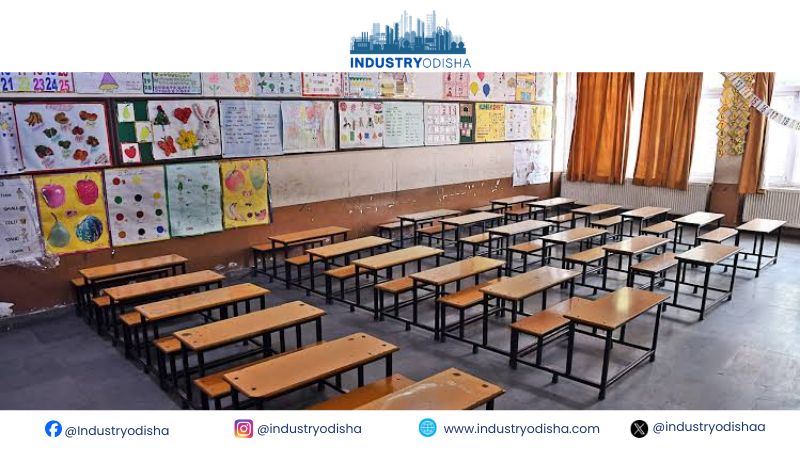
Industry Odisha Bureau, Aug 12: India’s public education system has reportedly witnessed a sorry state of affairs. Approximately, 84,000 government-run and government-aided schools across the country were closed down between 2018-19 and 2025-26. It was reportedly due to school rationalisation and changing demographics, while the enrolment also reportedly dropped by 15 million.
Media reports, citing data availed from the Unified District Information System for Education Plus (UDISE+) under the Department of School Education & Literacy (DoSEL) in the Union Ministry of Education, have stated that, “Over the past seven years, the number of government and government-aided schools has declined from 1.17 million to 1.08 million.”
Media reports, citing Niti Aayog’s recent report captioned ‘School Systems in Indiia’, have stated that, “The decline did not necessarily indicate reduced access. Instead, it reflects a consolidation of schooling infrastructure, particularly through measures such as school rationalisation, merging of under-enrolled institutions, and efforts to optimise resource. The focus was on improving quality, efficiency and sustainability, rather than only increasing the absolute number of institutions.”
Quoting the contentions of eminent educationists and academicians in this context, media reports have stated that, “Such measures by the Government may have resulted in more students falling out of the system, since the merger of schools increases distance, and that reduces the chances for the students to gain access, especially for the girls, because the parents do not feel safe.”
Highlighting inadequate basic amenities and poor learning outcomes in India’s public education system as have been revealed by the ground zero surveys, media reports have further stated that, “Nearly 63,000 government and government-aided schools in India lack access to functional toilets, while most of the government and government-aided Indian schools lag behind the private schools in terms of computer and internet facilities even though the the formers are ahead in access to libraries.”
Media reports, citing ground zero survey findings, have also added that, “There are poor learning outcomes in the government schools, especially in India’s rural pockets.”
Media reports, citing data availed from the Comprehensive Modular Survey: Education Report by the Ministry of Statistics and Programme Implementation (MoSPI), have also stated that, “Nearly 66% of the Indian students read in rural areas as against 30% in the urban areas, since more Indian children rely on the public education system in the rural areas.”
In this context, the educationists and academicians reportedly opine that, “The government-run schools, especially in rural India, must not be devoid of the basic inputs like the adequate numbers of qualified and diligent teachers imparting quality education, good infrastructures, accessible and affordable basic amenities, and quality of syllabi as well as textbooks.”
