


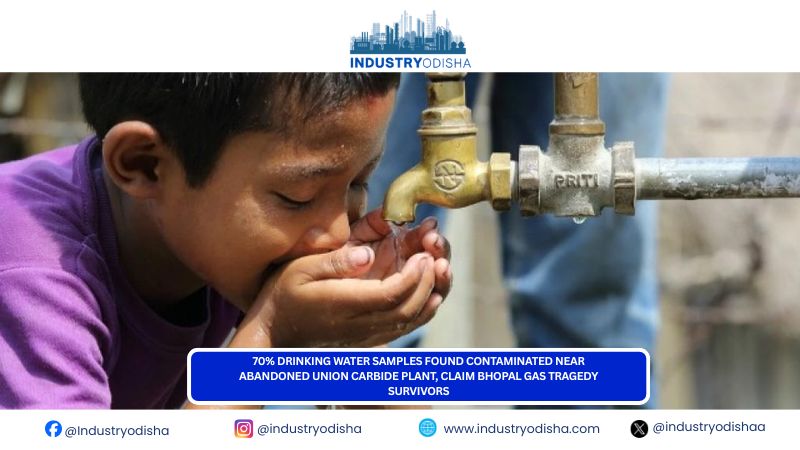
Industry Odisha Bureau, Aug 1: The organisations of survivors of the ill-famed Bhopal Gas Tragedy of 1984 have reportedly made a shocking claim before media yesterday that 70 per cent of the drinking water samples near the abandoned Union Carbide plant in Bhopal, capital city of Madhya Pradesh (MP), have been tested positive for faecal coliform contamination.
Media reports, citing the allegations made by the organisations of the Bhopal Gas Tragedy survivors yesterday, stated that, “Around 63 samples were tested from taps in 30 communities this month (July), and contamination was confirmed in 43 of them, while 90 per cent of samples from the Upper Lake supply and 25 per cent from the Kolar Dam supply were found contaminated. Residents living near the abandoned factory are suffering from diarrhoea, vomiting, and typhoid”.
Media reports, citing the allegations made by the organisations of the Bhopal Gas Tragedy survivors yesterday, also stated that, “Even though the Supreme Court had acknowledged groundwater contamination from hazardous waste dumped at the Union Carbide site in 2004, and had also ordered piped drinking water to protect the residents, that piped drinking water supply has also been found contaminated now.”
Notably, “The infamous Bhopal Gas Tragedy that occurred on the intervening night of December 2-3, 1984 is considered to be the world’s worst industrial disaster caused by a massive leak of methyl isocyanate gas from the Union Carbide India Limited (UCIL) pesticide plant located in Bhopal, the capital city of Madhya Pradesh (MP). When most of the residents had fallen asleep, the leakage of over 40-45 tons of lethal methyl isocyanate (MIC) gas into the surrounding neighbourhoods wreaked havoc resulting in chaos and mass casualties. Being heavier than air, the gas settled in low-lying areas, and also caused severe respiratory distress, eye irritation and chemical burns. While thousands of the residents got killed within hours, lots of them suffered long-term health hazards.”
