



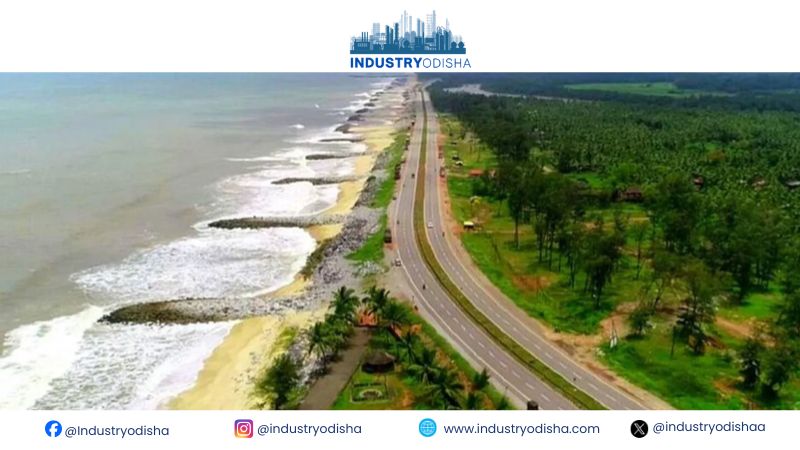
Industry Odisha Bureau, Aug 11: At least 28.3 percent of the 564.14 km Odisha coastline is undergoing erosion due to various reasons, according to a study conducted by the National Centre for Coastal Research (NCCR), Chennai, an office attached to the Ministry of Earth Sciences (MoES).
As per a data provided by Centre in the Parliament, the NCCR has carried out a comprehensive assessment and mapping of shoreline change analysis, along the Odisha coast for the period 1990–2022.
The study reveals that approximately 28.3 percent of the coastline is undergoing erosion, 17.6 percent remains stable (no significant shoreline change), and 54.1 percent is experiencing accretion.
The centre has been monitoring the shoreline erosion since 1990 using remote sensing data and GIS mapping techniques.
The six coastal districts of Odisha are—Ganjam, Puri, Jagtsinghpur, Kendrapada, Bhadrak and Baleshwar.
Of the 60.18 km coastline in Ganjam district, 45.7 percent facing erosion while 47.6 percent of 55.80 km long coast in Jagatsinghpur are also facing the issue.
Similarly, 45 percent of 149.36 km coastline in Kendrapara, 23.8 percent of 88.28 km long coastline in Balasore, 10.2 percent of 138.16 km coast in Puri and 4.6 percent of 72.36 km long Bhadrak coast are facing soil erosion.
North of Gopalur Port, Mayurpada to Bhramarakudi in Ganjam district; either side of Chilka Sea Mouth, Keutajanga, South of Devi River mouth, Devi River mouth in Puri; and Kusupur to Sahadabedi, Sahadabedi to Jatadhartanda in Jagatsinghpur districts are identified as most vulnerable stretches for soil erosion.
Similarly, Hetamundia, Hukitola, Pentha to Satbhaya, Satbhaya to Gahirmatha in Kendrapara, Amarnagar are in Bhadrak and Bagda, Chaumukh, Narayan Mohanty Padia, Bindhapadmapur to Talasari area of Kendrapara districts are also most vulnerable to erosion.
Experts said sea level rise is an increase in the level of the world’s oceans because of global warming caused due to burning of fossil fuels and emissions of heat-trapping gases into the atmosphere. This results in oceans getting warmer and sea levels rising worldwide.
Officials said that all non-major ports developed or under development in Odisha are under the Public-Private Partnership (PPP) mode. The respective port developers/ concessionaires are entrusted for ensuring the safety, sustainability and climate resilience of coastal areas and port infrastructure under their respective jurisdiction, including consideration of coastal hazards and environmental conditions, as applicable, while planning and executing port development works.
As per the applicable norms, Environment/ Coastal Regulation Zone (CRZ) clearance from the Ministry of Environment, Forests and Climate Change (MoEF&CC) and State Coastal Zone Management Authority (CZMA) is required for port infrastructure and development.
As stipulated by MoEF&CC and CZMA, studies like Environment Impact Assessment (EIA) and Environment Management Plan (EMP) are undertaken as a part of the development of the projects. Based on the studies for the project, requisite mitigation measures to protect the environment are undertaken.
In addition, MoPSW has issued dredging guidelines for major ports, applicable to Paradip port which is a major port in Odisha, to ensure implementation of dredging projects with optimum utilization of the resources and re-use of dredged material for sustainable development of ports.
Further, the Indian National Centre for Ocean Information &Services (INCOIS), Hyderabad, an autonomous institute of MoES, has assessed sea level change rate using tide gauge data at Paradeep (Odisha coast).
Analysis of Paradeep port tide gauge data showed a sea level change rate of 1.03 mm/year based on monthly mean data pertaining to the years 1966- 2005.
The 15th Finance Commission had recommended the creation of National Disaster Risk Management Fund (NDRMF) and State Disaster Risk Management Fund (SDRMF) comprising Mitigation Fund at the National and State level (NDMF/SDMF) and Response Fund at the National and State level (NDRF/ SDRF) for the award period from 2021-22 to 2022-26.
The Commission has also made specific recommendations for mitigation measures to prevent erosion under NDMF and resettlement of displaced people affected by erosion under NDRF, they said.
