



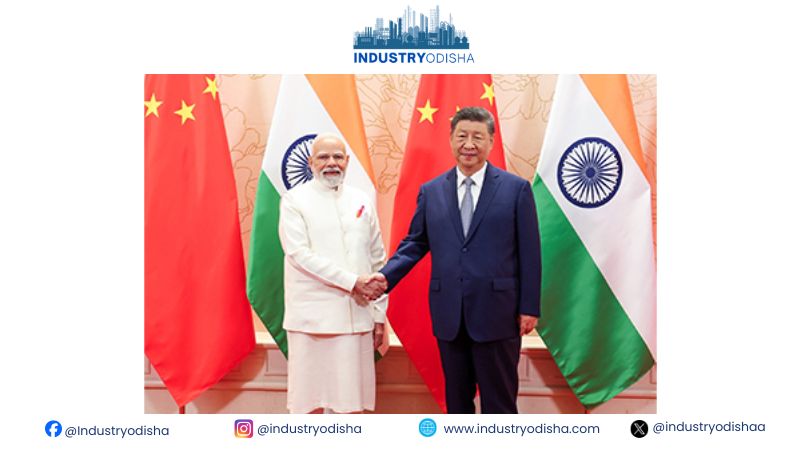
Industry Odisha Bureau, Sep 13: Narendra Modi and Xi Jinping met in New Delhi during the BRICS summit. Their talks addressed border peace, trade concerns and a cautious effort to stabilise India-China relations.
Prime Minister Narendra Modi met Chinese President Xi Jinping in New Delhi on Saturday. The talks took place on the sidelines of the BRICS summit. Xi’s visit was his first to India since 2019. The meeting marked another step in a cautious India-China thaw. Relations have remained strained since a deadly border clash in 2020. Modi thanked Xi for China’s cooperation in hosting the summit. China will host the summit next year.
Modi-Xi Meeting Puts Border Peace First
Modi said peace along the disputed border remains essential for wider ties. He urged both sides to honour existing agreements. Both leaders reaffirmed support for a fair, mutually acceptable boundary settlement. “Differences should not become disputes,” Modi said. He added that ties must rest on three mutuals. These are mutual respect, mutual sensitivity and mutual interest. No final settlement of the border dispute was announced.
Xi Seeks Strategic India-China Cooperation
Xi said Beijing views India from a “strategic and long-term perspective.” He called for both countries to support each other’s development. China and India were partners, not rivals, Xi said. He described both nations as major members of the Global South. Xi urged greater cooperation towards a more multipolar world. According to Xinhua, institutional exchanges have gradually resumed between the countries. The two leaders last met during Modi’s SCO visit in China.
India-China Trade Remains Complicated
The leaders discussed expanding business and people-to-people ties. Bilateral trade has continued growing despite political tensions. India raised concerns about trade imbalances during the talks. Supply-chain issues and market-access concerns were also discussed. Restrictions on Chinese investment and technology remain unresolved. No new trade or investment agreements were announced.
2020 Border Clash Still Shapes Relations
A deadly clash in 2020 badly damaged bilateral relations. At least 20 Indian soldiers were killed in the confrontation. Four Chinese service members also died in Ladakh. The clash triggered a long military standoff at the frontier. Each side has stationed forces backed by artillery, tanks and jets. India and China have taken steps to ease tensions. Deep mistrust between the two nations nevertheless remains.
Strategic Rivalry Remains
India’s expanding partnership with the United States concerns Beijing. New Delhi continues to strongly oppose China’s Belt and Road Initiative. Both countries have expanded infrastructure along the disputed frontier. India has also sought to attract manufacturers shifting away from China. Rising Chinese labour costs have supported that diversification effort. Competing strategic interests across Asia continue to strain relations.
Can the India-China Thaw Last?
Xi’s visit reflects renewed high-level engagement between the neighbours. It does not signal a full normalisation of ties. Leader-level dialogue and expanding trade mark genuine progress. Yet the border dispute, trade imbalances and strategic rivalry persist. The real test lies ahead: whether engagement can produce lasting stability.
