



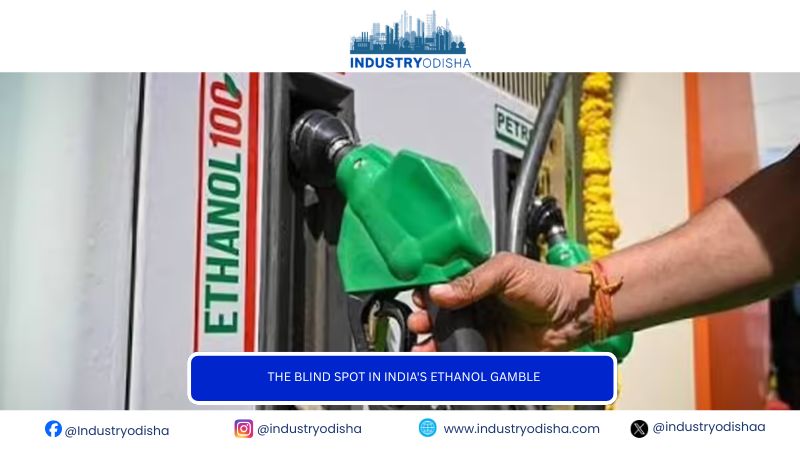
Industry Odisha Bureau, Jul 28: India’s push to reduce crude oil dependence through expanded biofuel adoption has collided with an uncomfortable reality: the government cannot say how many vehicles on the country’s roads are actually ready for it.
The Ministry of Heavy Industries has conducted no nationwide assessment of vehicle compatibility with E20 the fuel blend containing 20 percent ethanol according to clarifications provided this week by the Petroleum Ministry in Parliament. The admission exposes a gap in India’s otherwise ambitious clean-fuel transition strategy, which has positioned ethanol blending as central to energy security objectives.
For a country attempting to pivot its automotive ecosystem toward alternative fuels while managing one of the world’s most heterogeneous vehicle fleets, the lack of concrete data represents a significant coordination challenge. Manufacturers have certified certain models for higher ethanol blends, yet broad questions persist about real-world compatibility across India’s aging car population and the actual performance implications for consumers.
That uncertainty has fueled public concern, particularly regarding fuel efficiency. Technical studies have documented that blends containing 10 percent ethanol can reduce fuel economy by roughly 3 to 5 percent a figure that directly affects operating costs for transportation operators and individual drivers already sensitive to fuel expenses. The government has maintained that E20 fuel itself complies with existing technical standards, yet the absence of definitive vehicle-compatibility data creates a credibility gap between policy intent and consumer confidence.
India’s National Biofuel Policy and its ethanol-blending roadmap reflect sound strategic thinking. The world’s second-largest energy importer has legitimate reasons to diversify fuel sources and reduce crude reliance. Countries including Brazil and the United States have successfully scaled ethanol programs over decades, building flex-fuel infrastructure and consumer acceptance in parallel. India’s sugar industry and agricultural sector also stand to benefit from expanded ethanol procurement, diversifying farmer incomes and creating value-added opportunities.
The difference is timing and transparency. Rushing fuel composition changes across a vehicle population ranging from new flex-fuel models to decade-old engines creates operational friction. Without baseline data on compatibility and without consumers understanding which vehicles work safely with E20 public trust erodes precisely when it matters most for program success.
The government has signalled caution on this point. Officials confirmed this month that no decision has been made to push ethanol blending beyond the current 20 percent threshold. Any future increases would follow comprehensive scientific evaluation, manufacturer consultation, and stakeholder engagement with Oil Marketing Companies and research institutions.
That disciplined approach pending detailed assessment before scaling suggests policymakers recognise the risk. Yet the clarification itself raises the prior question: if nationwide vehicle compatibility remains unmeasured, how can the current E20 rollout proceed with genuine confidence? India’s energy transition strategy needs the answer before the scale of the question becomes apparent at the pump.
