



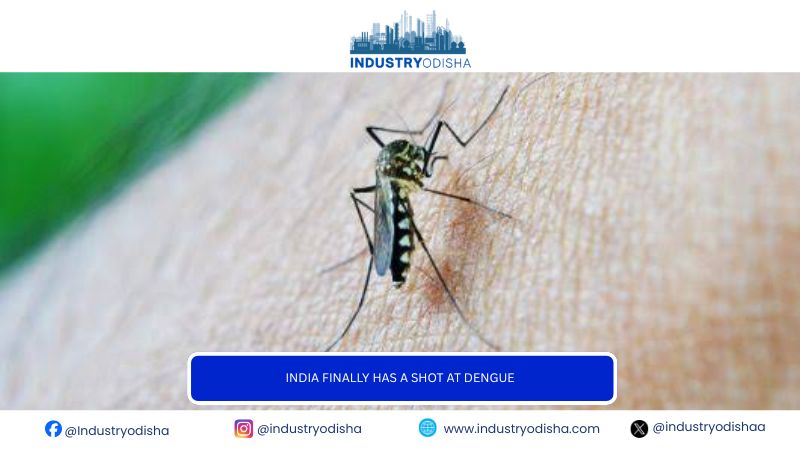
Industry Odisha Bureau, Jul 26: Every monsoon, India’s hospitals brace for the same surge: overcrowded wards, strained diagnostic labs, and millions of infections that drain public resources and idle workers across the country’s wettest months. India carries roughly one-third of the world’s dengue burden, yet until now its defenses consisted of what doctors have relied on for decades emptying breeding grounds, distributing nets, and urging households to cover water containers and clean out coolers. There has never been a specific treatment for the disease.
That calculus is changing. The approval of Qdenga, India’s first dengue vaccine, marks a departure from a reactive
posture and reflects a broader reorientation toward preventive medicine that could reshape how the country handles vector-borne disease for decades.
Dengue’s immunology explains why the milestone matters. The virus circulates in four distinct serotypes; infection with one confers immunity against that strain alone, leaving a person exposed to the other three. Second infections carry a markedly higher risk of severe disease, driven by antibody dynamics that can amplify illness rather than blunt it. Qdenga a live attenuated vaccine given in two doses is built to cover all four serotypes, targeting precisely that vulnerability by lowering the odds of severe dengue, hospitalisation and complications from secondary infection.
Officials have been careful about what the vaccine is not. It prevents rather than cures, does not fully eliminate the chance of infection, and should not be administered without medical consultation. Pregnant women, elderly individuals and those with an existing infection require assessment first constraints that rule out immediate universal rollout. Distribution will instead be prioritised by regional disease burden, transmission intensity, supply, age group and safety considerations.
Mosquito control remains the foundation. Aedes mosquitoes breed in the standing water of household containers, coolers and flowerpots; nets, repellents and full-sleeved clothing still form an essential layer. A vaccination programme that displaces this groundwork rather than reinforcing it would surrender much of its own advantage.
The approval also signals something about India’s vaccine ecosystem a growing domestic capacity to develop protection against diseases that rarely command global pharmaceutical attention. The economic argument is direct: fewer severe cases mean lower treatment costs, less lost productivity, and lighter pressure on hospitals during the weeks they are least able to absorb it.
Whether those gains materialise depends on execution, public confidence, and sustained commitment to the unglamorous work that must run alongside any campaign.
