


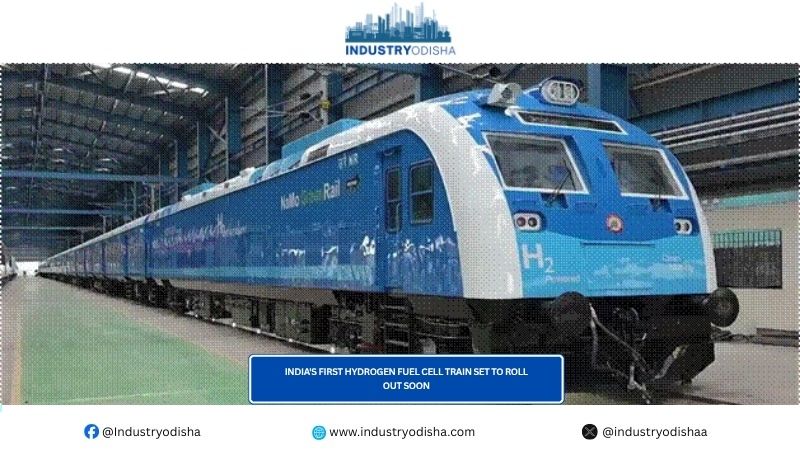
Industry Odisha Bureau, Jul 16: Indian Railways is set to flag off country’s first Hydrogen Fuel Cell Trainset, a train that generates its own electricity onboard using hydrogen, the cleanest fuel known. It produces near-zero emissions at the point of use.
This milestone marks the latest chapter in the evolution of how Indian Railways has powered its trains, reflecting India’s broader journey from coal and steam to cleaner, more sustainable sources of energy, the ministry said in a statement.
Over the past 12 years, rapid electrification has significantly reduced dependence on imported diesel, paving the way for the next leap in clean rail mobility. Today, with over 99% of Broad Gauge routes electrified, Indian Railways is taking that journey a step further, it said.
Unlike conventional electric trains that draw power from overhead lines, the Hydrogen Fuel Cell Trainset generates electricity onboard through a chemical reaction between hydrogen and oxygen, with water vapour as its only by-product.
In a sense, the train once again carries its own source of power, as steam and diesel locomotives once did. But instead of burning traditional fuels such as coal or diesel, hydrogen generates electricity inside the train using oxygen from the atmosphere, eliminating combustion and dependence on an external power supply.
As electricity is generated onboard through clean hydrogen technology, the train represents the greenest form of rail propulsion, powering the future of sustainable mobility.
To complement this advanced propulsion system, India has equipped the train with multi-layer safety systems capable of detecting hydrogen leaks, heat, flames and smoke. With an operational speed of 75 kmph on the Jind–Sonipat section and a design speed of 110 kmph, the train is not only safer but also faster on this 89 km route.
Most hydrogen passenger trains currently operating globally comprise only two or three coaches and are primarily deployed on short regional routes. In contrast, the Indian Railways train set has been configured as a 10-coach passenger train with a capacity of around 2,600 passengers, demonstrating the scalability of hydrogen-powered rail transport for high-capacity passenger operations.
But hydrogen is famously flammable, and that naturally raises a question in everyone’s mind: is it safe to put thousands of passengers on a train running on a gas that can catch fire so easily? Here is a simple explanation of how the train works, and everything Indian Railways has done to make it safe.
The train consists of two Hydrogen Driving Power Cars (DPCs) and eight Trailer Coaches (TCs). Each DPC houses fuel cells, lithium iron phosphate (LFP) batteries and hydrogen storage cylinders that work together to provide traction power while ensuring reliable operation under varying operating conditions.
The two power cars, one at each end, produce 1,200 kW (1600 hp) of power per DPC, together enough to push the entire train up to 110 km/h.
The Hydrogen Fuel Cell Powered Train will initially operate on the Jind–Sonipat section of Northern Railway, connecting Jind Junction, Gohana Junction and Sonipat while serving intermediate stations and proposed halts including Jind City, Pandu Pindara Junction, Lalit Khera Halt, Bhambhewa, Isapur Kheri Halt, Butane Halt, Khandrai Halt, Rabrah Halt, Lath Halt, Mohana, Barwasni Halt and Sonipat New.
The route has been selected for demonstrating the operational viability, safety and reliability of hydrogen-powered passenger train services under regular operating conditions. The dedicated hydrogen storage, compression and dispensing facility established at Jind will support refuelling operations, creating India’s first integrated hydrogen railway ecosystem.
How Does a Hydrogen Train Actually Work?
Unlike conventional diesel locomotives that burn fuel to generate mechanical power, a hydrogen train carries a small power plant onboard in the form of a Proton Exchange Membrane (PEM) fuel cell.
Hydrogen stored in the train’s cylinders combines with oxygen from the surrounding air inside the fuel cell, producing electricity that powers the traction motors and turns the wheels. The only direct by-products of this electrochemical reaction are water vapour and heat. There is no combustion, no smoke and no tailpipe carbon emissions.
In simple terms, the process is almost like magic: Hydrogen + Oxygen → Electricity + Water Vapour → The Train Moves. What appears to be magic is actually clean science at work, converting hydrogen directly into electricity inside the train. The only direct by-product is water vapour. There is no smoke or direct carbon emission, contributing to a greener Indian Railways.
So How Is Safety Actually Ensured?
Safety has been built into every layer of the project. From the design of the train and hydrogen storage cylinders to refuelling infrastructure, monitoring software and emergency response systems. Rather than depending on a single protective measure, Indian Railways has adopted the internationally accepted principle of defence in depth, where multiple independent safety systems continuously monitor, verify and protect every stage of hydrogen storage, transfer and utilisation.
Where Does India Stand Globally?
Hydrogen-powered trains are still at a nascent stage globally. Germany became the first country to introduce commercial hydrogen passenger trains, while France, Italy, China, Japan and a few other countries are pursuing pilot projects or limited deployments. However, these trains typically comprise two to four coaches and are intended primarily for regional passenger services.
India’s Hydrogen Fuel Cell Trainset represents a significant advancement in both scale and ambition. Beyond the train itself, India has also established the country’s largest railway hydrogen refuelling facility at Jind, creating a complete hydrogen rail ecosystem encompassing rolling stock, storage, dispensing infrastructure, safety systems and operational protocols.
Future of Hydrogen Trains
Indian Railways is also exploring the deployment of hydrogen technology on heritage railways, including the Kalka–Shimla route, by leveraging the experience gained through the Jind–Sonipat Hydrogen Train project.
These initiatives signal Indian Railways’ transition from a pioneering pilot project to a structured national programme for hydrogen-powered rolling stock, reinforcing India’s leadership in sustainable mobility while contributing to the National Green Hydrogen Mission and the country’s long-term Net Zero goal.
