



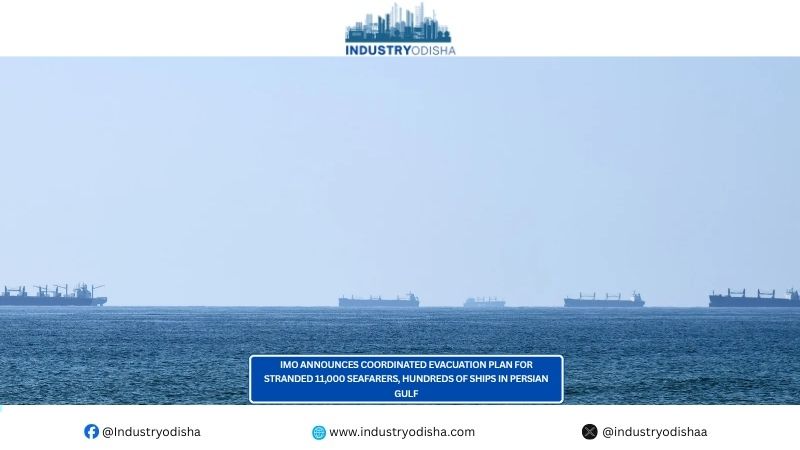
Industry Odisha Bureau, Jun 24: In a bid to safely evacuate hundreds of ships and their 11,000 crew members stranded since long in the Persian Gulf as Iran had closed the Strait of Hormuz followed by the US naval blockade of Iranian ports in retaliation during the months-long West Asia conflict, post-peace deal now, the International Maritime Organization (IMO) has reportedly announced a coordinated evacuation plan for them.
IMO Secretary-General Arsenio Dominguez reportedly stated that: “The evacuation plan of action will be operated in close coordination with Iran, Oman, United States of America (USA), coastal states in the region, maritime industry stakeholders.”
The IMO Secretary-General also reportedly stated that: “Before launching the coordinated evacuation operation, not only requisite safety guarantees have been secured, safe navigation conditions have also been thoroughly verified.”
It has also been reported that, “Two alternative transit routes will now be preferred since the Strait of Hormuz is considered unsafe because of the presence of mines and other navigational risks. The two alternative transit routes, opted for the evacuation purpose, have been chalked out as ‘a southern route along the Omani coast’ and ‘a northern route along the Iranian coast’. Ships have been asked to coordinate with the relevant coastal state before transit.”
IMO has further reported that, “A phase-wise evacuation process will be strictly followed to minimise risk. Accordingly, the stranded vessels will not move simulataneously, but will be grouped into phases. While each vessel will be individually contacted, each will receive an assigned transit day.”
Reportedly, the IMO’s coordinated evacuation plan underlines: “The two alternative adhoc transit routes along the Omani and Iranian coasts have the capacity of accommodating only 20-30 vessels per day instead of 130 vessels that used to transit per day prior to the conflict. Thus, all have to cooperate with patience since the clearance of all the stranded vessels is expected to consume a considerable timeline.”
The IMO has also reportedly laid stress that, “Each vessel must coordinate with the coastal authorities as well as ensure keeping their individual Automatic Identification System (AIS) operational throughout the transit.”
