



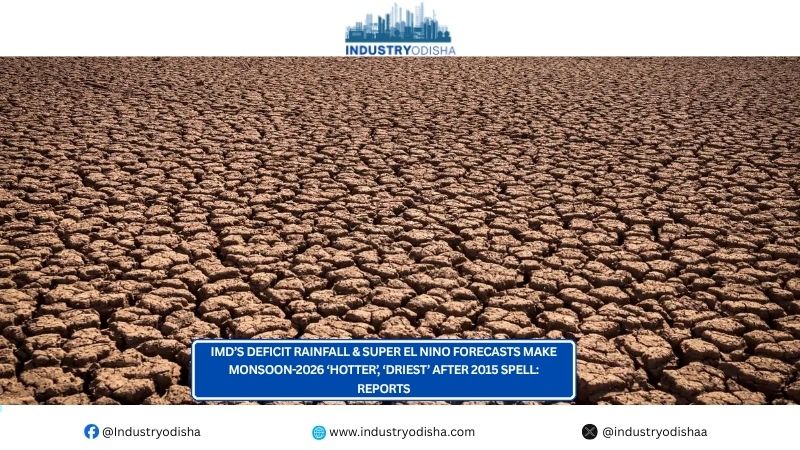
Industry Odisha Bureau, Jun 1: Following the India Meteorological Department (IMD)’s reportedly reiterated forecasts predicting a below-normal downpour during this year’s monsoon season as well as a prolonged impact of the Super El Nino persisting into next year, weather experts reportedly anticipate a hotter along with driest monsoon season since 2015.
Generally, “The hot and dry monsoon in India is characterized by the Southwest Monsoon which typically begins in June and continues until September. It brings moisture-laden winds from the Indian Ocean and causes significant rainfall across the country. Thus, the country experiences heavy rainfall vital for agriculture and also replenishes water resources. It is crucial for India’s agrarian economy, ecology, filling rivers and other water bodies and generating hydro-electricity. The annual monsoon season in India is also associated with high temperatures and humidity levels.”
As per the reportedly latest IMD update on monsoon, “it is likely to be 90% of the long period average (LPA), instead of 92% LPA projected in April.”
Notably, “Rainfall is considered normal when it falls in the range of 96–104% LPA, while IMD forecasts it likely to be 84% LPA this year, that is being reportedly dubbed to be below-normal.”
As per reports, it is being expected that this month (June) “would also be hotter than normal with above-normal heatwave days likely to sweep several states, including Odisha, in India.”
If the IMD’s below-normal monsoon and Super El Nino forecasts hold water, experts have reportedly concluded that, “this year would be experienced not only as “hotter”, but also “the driest” monsoon season after a long gap of 11 years, since 2014 and 2015 have been recorded to be consecutive drought years owing to 88% and 86% LPA rainfall during those two monsoon seasons respectively”.
Experts have already warned of a potential Super El Nino this year that is “expected to persist into next year pushing the global temperatures to record heights even in 2027 and trigger devastating weather extremes worldwide. It could even make 2027 the hottest year on record. Besides, it is strongly associated with deficient monsoon rainfall in India that could lead to widespread drought, impacting agriculture and rural livelihoods.”
