

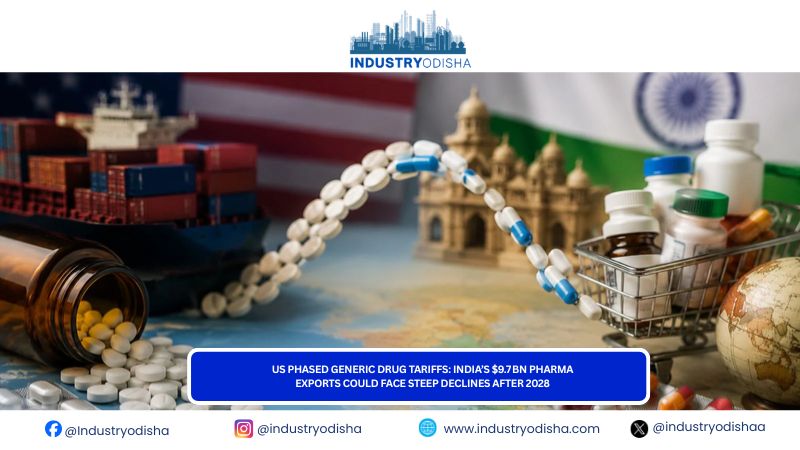
Industry Odisha Bureau, Jul 29: In the wake of Donald Trump-led US regime’s imposition of phased generic drug tariffs on India’s pharma exports, analysts have reportedly contended that India’s $9.7 billion pharma exports to the US could face steep declines after 2028, especially in higher‑value generics, as tariffs rise to 100% in 2028 and 200% from 2029, forcing diversification and possible US‑based manufacturing.
As per media reports, “While generic medicines will remain tariff‑free from August 1, 2026 to August 1, 2028, it is going to face 100% duty for one year and 200% duty from August 2029 under the latest US plan. However, branded and patented drugs are not covered by this specific measure”.
Media reports quoting analysts and experts have stated that, “The short term period of zero tariifs from 2026 to 2028 would give Indian exporters a breathing space as some may use this to expand US‑based production or secure supply contracts, while low‑cost generics may remain competitive even after 2028 due to price advantage.”
Similarly, media reports quoting analysts and experts have stated that, “The medium term phase of 100% tariff from 2028 to 2029 could sharply reduce volumes in higher‑value generics and branded generics as US‑based production becomes viable, while price increases may be passed to the US payers.”
Media reports quoting analysts and experts have also stated that, “The long-term period of 200% tariff from 2029 onwards is among the steepest on pharma imports; could force major Indian exporters to diversify markets like Europe, Latin America, Africa, Asia, and invest in US manufacturing to avoid penalties.”
In this context, the Indian research organization Global Trade Research Initiative (GTRI) has reportedly warned that, “India should reduce dependence on the US and on China for the Active Pharmaceutical Ingredients (APIs).”
Notably, “Active Pharmaceutical Ingredients (APIs) are distinct from raw materials, which are the chemical compounds used to manufacture APIs. Each drug typically contains two main components: the API and the excipient. The excipient is an inactive substance that serves as the vehicle for the API, aiding in the delivery of the drug to the target system.”
