



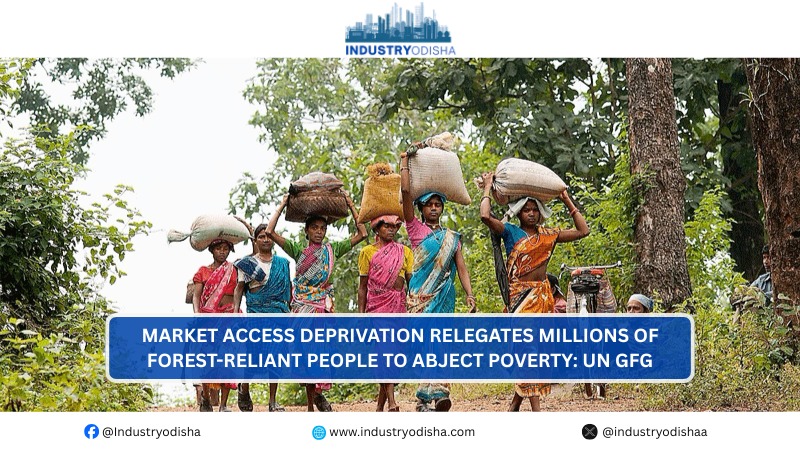
Industry Odisha Bureau, May 13: Although bestowed with a flourishing economy in shape of forest, and despite the forest sector claimed to be accounting for one per cent of the global working population, the stark paradox startles the intelligentsia to discover that those millions of forest-reliant as well as usually poor people are still languishing in abject poverty being deprived of access to proper marketing facilities.
In this context, the United Nations Organisation (UNO)’s ‘Global Forest Goals Report 2026’ has reportedly found out “lack of access to markets keeps millions of forest-dependent people in extreme poverty globally.”
Notably, millions of people and communities across the globe heavily depend on forests for their daily survival, economic livelihood, and well-being.
As per the UN Report, “The forestry, with an estimated annual worth of $1.5 trillion and despite being the source of sustenance for those millions of people, is not significantly contributing to the expected decline in their poverty level.”
Pertinent to note here that, the UN General Assembly has reportedly adopted the “UN Strategic Plan for Forests 2017-2030” on April 27, 2017 setting six Global Forest Goals (GFGs) to be met by the member nations by 2030.
While the first GFG reportedly targets “Eradication of extreme poverty of all forest-dependent population”, the second one is: “To enhance forest-based economic, social and environmental benefits.”
Notwithstanding that, assessment made in the UN’s ‘Global Forest Goals Report 2026’ released on late Monday reportedly states, “Despite submission of action taken reports by the countries, renewed efforts must be made to eradicate extreme poverty for all forest-dependent people, serious challenges still remain in relation to improving the livelihoods of forest-dependent people.”
The UN’s 2026 assessment report has reportedly blamed “the the non-realisation of the economic and social benefits of forests … constrained by weak market access and limited opportunities for value-added processing and commercialization, especially for NWFPs (non-wood forest produce, or minor forest produces.”
It has also reportedly underlined, “Inadequate development of standards and marketing problems which result in forest producers and communities remaining at the low-value end of supply chains.”
As per the data quoted in the UN’s GFG assessment, “Three-quarters of the world population use NWFPs, whose value was $9.4 billion in 2020.”
