



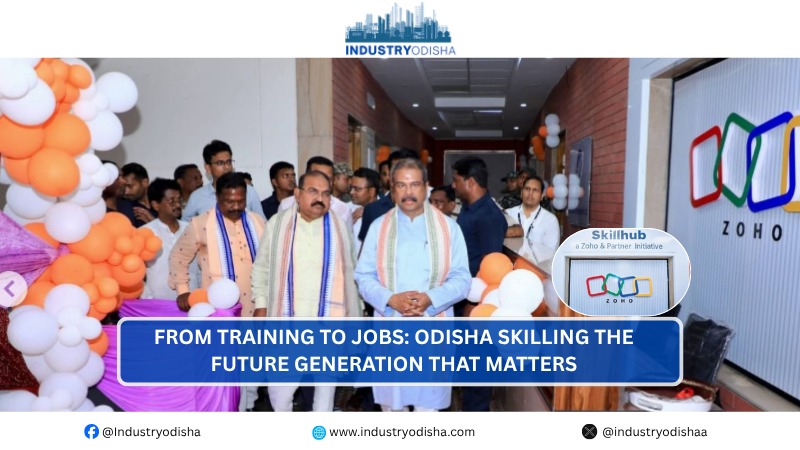
Union Education Minister Dharmendra Pradhan recently inaugurated the ‘Zoho Skill Hub’ at Veer Surendra Sai University of Technology (VSSUT), Burla. The Zoho Skill Hub, established in collaboration with Zoho Corporation, aims to equip students and local youths with advanced technological and software skills and will offer hands-on training through modern classrooms and industry-linked exposure, enabling learners to gain real-world experience and improve employability.
The inauguration of the skill hub announces the emergence of Odisha as a skill hub. Earlier this year, the state government had announced plans to transform 47 Industrial Training Institutes (ITIs) into Centres of Excellence and introduce AI laboratories across select institutes, signalling a decisive shift toward future-ready skilling.
Importantly, the state is not just focusing on training people but increasingly shaping a workforce that matches India’s future economic priorities.
According to Government data, between 2011–12 and 2021–22, over 1.03 lakh youth were trained and nearly 30,000 placed in jobs under placement-linked programmes alone. More recently, the state trained over 36,000 youth in five years, with more than 15,000 securing employments, reflecting a placement rate of around 40 percent.
In fact, the state now has over 400–500 training centres and nearly 200 training providers, with enrolments crossing 1.5 lakh candidates in a single year. The ambition is even more striking: the state aims to skill one million youth annually by 2047, signalling a long-term vision aligned with India’s demographic trajectory.
Interestingly, Odisha’s approach is not just about numbers—it is about who gets skilled. Around 25% of trainees are women and nearly 30% come from disadvantaged groups, reflecting a conscious attempt to make skilling inclusive. Dedicated programmes for tribal youth, SC/ST communities and rural populations have expanded the reach of formal training into regions historically excluded from growth.
The emphasis on industry linkage has made it even more definitive. Unlike earlier models where training often failed to translate into employment, Odisha has increasingly adopted placement-linked incentives and public-private partnerships. The government has signed multiple MoUs with private companies to co-design training and absorb candidates, reducing the gap between curriculum and market demand. The ₹779-crore partnership with Tata Technologies to upgrade 22 ITIs with industry-grade infrastructure in areas such as electric vehicles, robotics, and advanced manufacturing by the state government is a case in point.
The state is also aligning skilling with emerging sectors. Training programmes now extend beyond traditional trades like plumbing or tailoring to include healthcare, hospitality, logistics, and digital services. Institutions such as the World Skill Centre in Bhubaneswar and collaborations in areas like AI training signal a shift towards higher-value capabilities.
The Odisha Skill Development Authority (OSDA), established in 2016, has also streamlined a once-fragmented skilling ecosystem into a more coordinated, outcome-oriented model. By aligning with national frameworks like the Skill India Mission while adapting to local needs, the state has built both scale and flexibility into its approach.
Why this shift
Economic necessity is the prime driver of this shift. It is important to note that Odisha has historically witnessed large-scale migration of workers, often in low-skilled, informal jobs. The policy response, therefore, has been to convert this demographic reality into an advantage. By investing in skill development, the state aims to ensure that migration leads to higher wages and better working conditions rather than distress-driven survival.
Secondly, skill development enables diversification of growth models by expanding it beyond mining and heavy industry. Though these sectors generate revenue, they are capital-intensive and create limited jobs relative to the size of the workforce. Skilling allows the state to expand into labour-intensive and services sectors such as manufacturing, logistics, healthcare, tourism, where employment elasticity is much higher. In simple terms, skills help convert growth into jobs.
Thirdly, focusing on skill development addresses employability gap by training youth to enter labour market with job ready skills. Institutions such as the Odisha Skill Development Authority, designed to bridge this gap by aligning training with actual industry demand rather than generic curricula, are notable changes.
Moreover, it enhances income stability and resilience.
Skilled workers are more likely to secure formal or semi-formal employment, earn higher wages, and withstand economic shocks. For a state vulnerable to climate events like cyclones, this resilience is crucial. A skilled workforce can recover faster and diversify income sources beyond agriculture.
For decades, Odisha’s economic story was dependent on its abundant natural resources, coal, iron ore, bauxite, contributing significantly to state revenues. However, being capital intensive, it generated relatively fewer jobs for a young and expanding workforce.
Emphasis on skilling is a step towards correcting the imbalance. By investing in human capital, Odisha is broadening the base of its growth. A skilled workforce enables the expansion of labour-intensive sectors such as manufacturing, logistics, tourism, and healthcare, areas that can absorb large numbers of workers while creating more distributed economic opportunities.
In a nutshell, Odisha is not merely responding to current labour market needs; it is preparing its workforce for the demands of tomorrow.
