



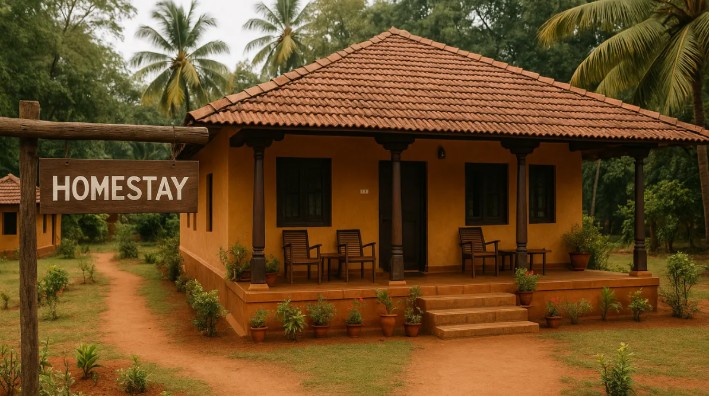
In a bid to promote community‑based tourism, support local entrepreneurs and create sustainable livelihood opportunities in rural and semi‑urban areas, the government of Odisha recently launched the Go Homestay Portal. The portal, a part of the state government’s efforts to promote rural development, seeks to transform local homes into guest accommodations by preserving cultural heritage, and expanding tourism beyond traditional urban centres.
Homestays are intrinsic to Indian culture long before it took the shape of structured tourism. Rooted in the philosophy of ‘Atithi Devo Bhava’(the guest is akin to God), Indians accommodated visitors, pilgrims and travellers in private homes, dharamshalas and community spaces, often referred to as sarais.
The belief that was inherent in our culture became formalized as a tourism model post economic liberalization in 1991 when states like Kerala initiated homestay policies under its ‘Responsible Tourism’ framework. Soon after, hill states such as Himachal Pradesh and Uttarakhand adopted similar models in the early 2000s.
The final push came when the Union ministry of tourism formalized homestays through the ‘Incredible India Bed and Breakfast scheme in 2005, formally standardising and classifying homestay accommodations, especially in urban areas, to cater to budget and experiential travellers.
With the rise of digital platforms such as Airbnb, OYO (founded by a native of Odisha), homestays have scaled into a nationwide model for community-led tourism. Inspired by its success and its economic potential, Odisha has also stepped in to rewrite its tourism sector by replicating the Homestay model.
How Homestays are scripting Odisha’s growth story
In recent years, Homestays in Odisha have emerged as a key driver of decentralised growth, rural employment, and MSME expansion. From a mere 50 in 2017 to over 350 in recent years, there has been a seven-fold surge in the growth of Homestays.
In fact, they have bridged the accommodation gap, one of the major challenges that the state government faced in accommodating tourists due to shortages of hotels, especially in rural and remote areas. With the state witnessing a significant surge in foreign tourists arrivals (FTA) in 2024, reaching 53,392, a whopping 18% increase from 45,173 recorded in 2023, and domestic tourist inflow increasing by 13%, from 9,725,184 in 2023 to 10,998,819 in 2024, as per state tourism department records, the homestays have filled in the gap in places where building hotels are not economically viable.
It has also played an important role in alleviating the livelihoods of not just the owners of the property but also the farmers who supply food, drivers responsible for transportation, tourist guides and handicraft weavers and sellers. In other words, by converting tourism into localized value chain, homestays have helped in keeping money circulating within rural economies rather than flowing out to large operators.
Moreover, they have boosted local economy, encouraging the state government to target eco-tourism activities in rural areas. The government’s plan to set up 10 lakh green livelihoods through engagement in eco-tourism activities by establishing 100 facilities to process medicinal plants is a case in point. Ek Ped Ma Ke Naam 2.0 is one such initiatives.
More importantly, homestays have also emerged as an opening to MSME growth. It has encouraged families to convert existing homes into income-generating assets with modest investment. Besides, the financial risk is minimal as government provides subsidies up to several lakh rupees per unit. Interestingly, it has provided an opportunity to women to become first generation entrepreneurs, making them financially independent.
Strengthening tourism brand beyond temples and beaches
Homestays have also helped Odisha to reposition itself in India’s tourism landscape. The state, which was known for Jagannath Temple in Puri and its beaches, is increasingly promoting experiential tourism—village stays, eco-tourism, tribal culture, coffee trails and nature tourism.
Places like Chilika Lake, India’s largest coastal lagoon, has emerged as a major hub for homestays, especially in areas like Mangalajodi and Satapada. Similarly, Daringbadi, often referred to as the ‘Kashmir of Odisha’ and Deomali Hills in Koraput have seen a steady rise in homestay catering to tourists, who are drawn to its cool climate, coffee gardens and tribal culture.
In villages like Dangmal in Kendrapara, they are also gaining traction. Even remote areas near Hirakud Dam and places like Zero Point (Bargarh) are getting noticed.
In short, homestays across the state have penetrated where tourism was unexplored, rewriting the tourism story of Odisha not just nature-ully but also economically. They are turning Odisha’s most remote regions into centres of economic activity, bringing tourism income directly into village households.
Also Read :- Vedanta Aluminium’s Jamkhani Coal Mine Scores Big at DGMS Annual Mines Safety Fortnight
