



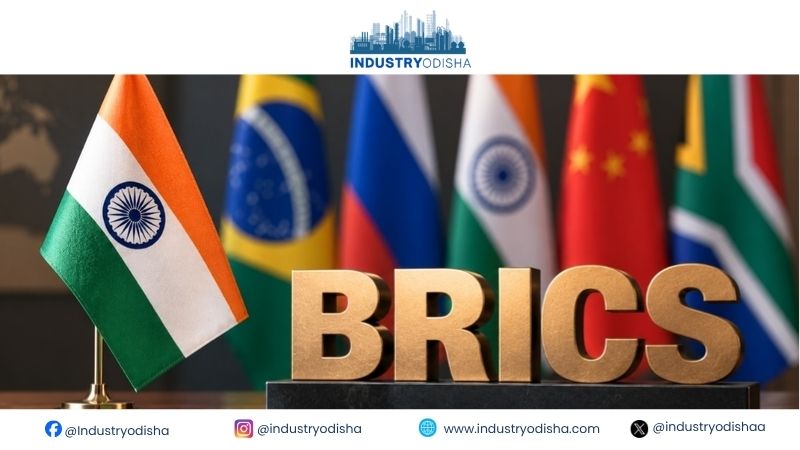
Industry Odisha Bureau, Sep11: India is unlikely to back a common BRICS currency at the Delhi summit. Instead, it favours linking payment systems and CBDCs. Trade imbalances still pose a serious settlement challenge.
India looks set to avoid backing a common BRICS currency. The BRICS summit takes place in New Delhi on September 12 and 13. Instead, it wants better cross-border payments across the bloc. CBDCs and national payment links form its preferred approach.
India rejects a common BRICS currency
India does not support creating a new BRICS currency. Commerce Minister Piyush Goyal stated this on August 7. He said India opposed any BRICS currency scheme. A shared currency would mean a new monetary unit. That differs sharply from linking existing payment systems. Countries would keep using rupees, yuan and roubles.
RBI pushes CBDC interoperability
The Reserve Bank of India has proposed CBDC interoperability. Reuters reported the recommendation in January 2026. The idea involved connecting official digital currencies across BRICS. The proposal built on the 2025 Rio BRICS declaration. That declaration favoured stronger payment-system interoperability. Possible uses include trade settlement and tourism payments. RBI Governor Sanjay Malhotra confirmed such discussions in August. He said various options remained under consideration. The proposal remains exploratory, not an approved network. No bloc-wide CBDC system has yet been agreed.
CBDC is not UPI or a new currency
A CBDC is sovereign money issued electronically by a central bank. India’s version is the digital rupee, known as e₹. The RBI launched its retail pilot in December 2022. UPI moves money between existing bank accounts. A CBDC itself is central-bank-issued digital money. The two systems remain distinct concepts.
India-Russia trade exposes a settlement problem
Local-currency settlement faces a practical economic problem. India’s imports from Russia rose sharply after the Ukraine war. Russia consequently accumulated large balances of Indian rupees. Russia sold considerably more to India than it bought. The RBI allowed those balances to be invested in securities. Bilateral foreign-exchange swaps have also been explored. Weekly or monthly settlements through swaps were reportedly considered. That demonstrates why payment technology alone cannot fix imbalances.
Technology cannot solve unequal trade
Payment interoperability can reduce transaction friction. It cannot automatically balance bilateral trade flows. Countries must still agree on technology and governance. Different nations may prefer different digital platforms. Reuters reported this could complicate progress. Consensus on regulation and settlement remains necessary.
De-dollarisation remains a sensitive backdrop
India has encouraged wider international use of the rupee. New Delhi says this is not aimed at de-dollarisation. S Jaishankar made that distinction in December 2024. Donald Trump has separately warned against a replacement currency. He threatened tariffs of up to 100%. Russia’s Dmitry Peskov also denied seeking de-dollarisation on September 8. He said 90% of Russia-BRICS trade uses national currencies. Peskov added that excess Indian rupee balances were gradually easing.
What could emerge from the Delhi summit
India appears to favour stronger links between fast-payment systems. Local-currency trade settlement is also under discussion. CBDCs could potentially play a supporting role. Vladimir Putin will attend the summit and meet Narendra Modi. Final decisions on the agenda remain pending. New Delhi’s message is nonetheless clear. Rather than create new money, BRICS should move existing money better. The approach favours incremental change over monetary union.
