



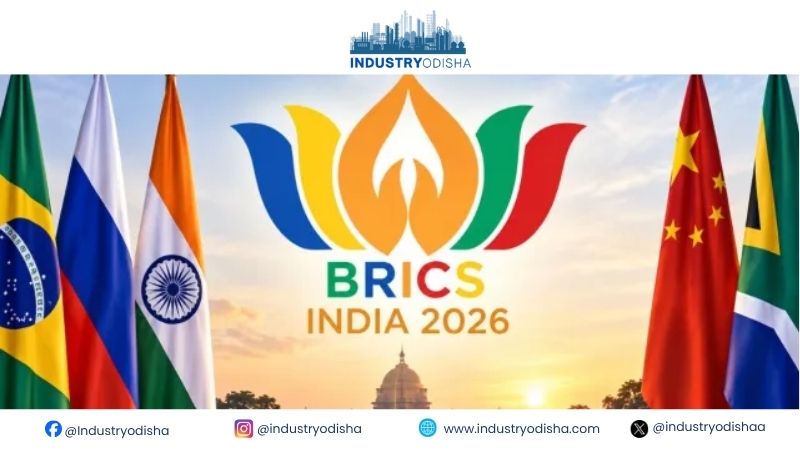
Industry Odisha Bureau, Sep 11: India hosts the 18th BRICS summit on September 12-13. The bloc arrives bigger and economically heavier than ever. It also arrives more divided than before.
A Larger, Heavier Bloc
BRICS has grown from five founding members to 11. Indonesia is the newest addition. The group’s global GDP share rose to 29.1% in 2025. That’s up from 19.7% when BRICS formed in 2009. China alone accounts for 60.4% of that combined GDP. India and Russia add further economic weight. The G7’s GDP advantage has narrowed too. It stood near 33 percentage points once; now it’s about 15.
Bigger Bloc, Harder Consensus
More members bring more competing interests. This year’s clearest fault line ran through West Asia. The UAE, Saudi Arabia and Iran sit on opposing sides of that conflict. Iran has launched attacks against both Gulf states. Saudi Arabia is a key US ally, sharpening the contradiction. A BRICS foreign ministers’ meeting in New Delhi ended without a joint declaration. India issued only a chair’s statement instead. India and China’s own rivalry adds another layer of friction.
Currency Diversification, Not Dollar Replacement
BRICS has pushed to reduce dollar dependence. US President Donald Trump last year threatened 100% tariffs over the effort. Wider de-dollarisation, though, remains unlikely soon. Still, the New Development Bank shows gradual change. Dollar financing there has slipped below 60% of projects. The Chinese yuan is now a significant alternative. Other currencies, including the South African rand, have gained ground too.
That shift is uneven across countries. Yuan financing covers 73.3% of NDB project value in China. Rupees cover 57% of financing within India. The rand accounts for 29% of South African projects. The euro and Swiss franc still matter in China, Brazil and Russia. This points to gradual diversification, not dollar abandonment.
Trade Ties Deepen
Intra-BRICS+ trade has grown sharply since 2009. UN Trade and Development data puts 2025 intra-bloc trade at $1.2 trillion. On an index rebased to 100 in 2009, BRICS+ trade reached 307 by 2025. That outpaces Southeast Asia’s 210, and the G20 and EU, both under 200.
India’s Lopsided Trade
Growing trade hasn’t benefited all members equally. BRICS+ supplies 41.5% of India’s imports. China, the UAE and Russia account for much of that. Yet the bloc takes only 22.3% of India’s exports. India holds free-trade agreements with just two members, the UAE and Indonesia. As BRICS+’s second-largest economy, India has real stakes in narrowing that gap.
The Bottom Line
BRICS+ has clearly grown economically stronger and more interconnected. Whether it can translate that scale into genuine cohesion remains unresolved.
