



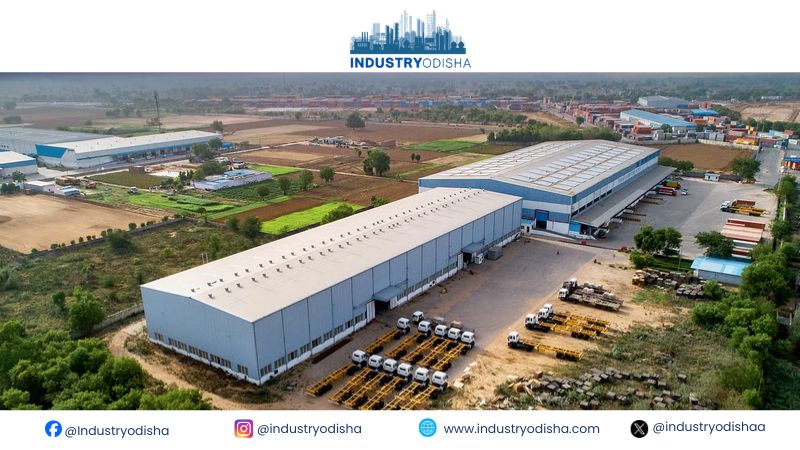
Industry Odisha Bureau, Sep 09: India’s factory leasing could reach 30-32 million square feet annually by 2030. That is up from 21.3 million square feet in 2025. Savills projects the increase in a new report. Capacity expansion and deeper localisation are driving the shift. The projection reflects broader manufacturing expansion nationwide.
Rising factory leasing reflects real demand for industrial capacity. It signals new production lines, not just paper announcements. Leasing activity connects directly to supply-chain investment decisions. It also reflects growing export-oriented manufacturing capacity.
Leasing alone does not guarantee manufacturing success, however. It also signals stronger investment in supply-chain depth.
Traditional sectors still dominate current leasing activity. Auto and auto components made up 29% between 2020 and 2025. Electrical and electronics accounted for another 18% share. Machinery and equipment contributed about 9% of leasing. Renewable energy added roughly 8% to the total. Newer sectors are steadily building a bigger footprint. These include semiconductors, electric vehicles and energy storage. Aerospace and defense manufacturing is also gaining ground. Together, these emerging sectors are diversifying India’s manufacturing base.
Facilities themselves are also getting considerably larger. Average leased space rose from 71,000 square feet in 2022. It reached about 94,000 square feet by 2025. Occupiers are consolidating operations into large, Grade-A spaces. That shift supports automation and sustainability requirements better. Fewer, larger facilities can also improve operational efficiency.
Manufacturing leasing remains concentrated in a few hubs. Pune led with 26.7 million square feet leased. Chennai followed with 9.4 million square feet. Bengaluru remains another significant manufacturing centre. The National Capital Region is steadily gaining traction too. Hosur and Ahmedabad are also emerging as manufacturing markets. Industrial corridors could help extend growth to newer regions.
India’s industrial land base underpins this expansion. The country counts 4,249 industrial parks nationwide. These parks span roughly 1.6 million acres combined. More than 253,600 acres remain available for development. Ready land can reduce delays in factory expansion. Nearly 415,000 industrial plots remain vacant and available.
Government programmes have supported this manufacturing push. These include Make in India and PLI schemes. Global supply-chain diversification has also played a role. Such factors are contributing influences, not guaranteed outcomes. Localisation efforts have encouraged deeper domestic manufacturing investment.
International occupiers dominate India’s manufacturing leasing activity. European companies accounted for 44% between 2020 and 2025.
APAC occupiers followed with a 31% share. Demand from the Americas and Middle East remained smaller. This mix reflects India’s growing role in global manufacturing networks. Their presence highlights confidence in India’s manufacturing environment.
Whether the 2030 target is met remains uncertain. Infrastructure, land readiness and logistics will all matter. Electricity reliability and skilled labour supply are also important. Export competitiveness will ultimately shape long-term demand. Savills describes the coming years as a transition period.
