



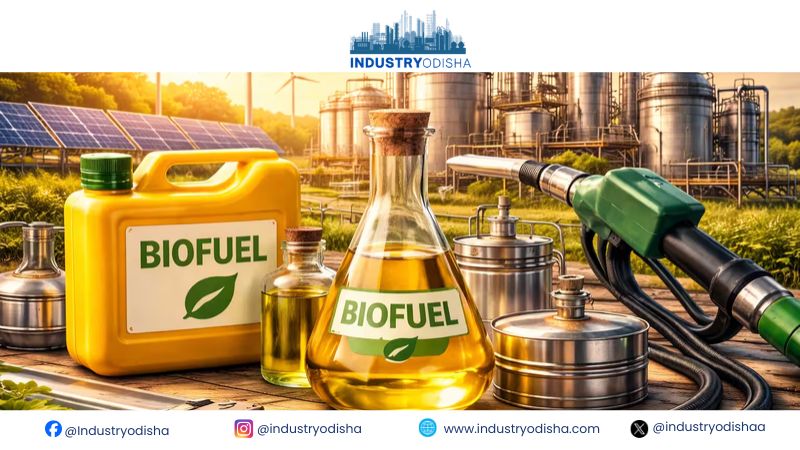
Industry Odisha Bureau, Sep 08: India’s shift toward alternative fuels is broadening beyond ethanol. Biofuels now anchor a wider energy-security strategy. Principal Scientific Advisor Ajay Sood frames this shift as unavoidable.
Sood told ET that biofuels carry strategic weight. Ethanol remains one hydrocarbon among several options. Butanol offers higher energy density and can be produced biologically. “Biofuels, in general, will be important for energy security,” Sood said. That framing extends beyond any single fuel type. Methanol and butanol both feature in India’s alternative fuel mix.
Biodiesel represents a more developed pathway already. Sood said India has developed relevant technology domestically. Bio-jet fuel has followed a similar development path. CSIR-IIP in Dehradun built these indigenous technologies last year. Feedstocks include non-edible vegetable oils and used cooking oil. Waste oils and agricultural waste also serve as inputs.
The institute has since transferred nearly 50 technologies. These target commercial-scale production across multiple applications. Not all fifty concern Biodiesel specifically. Green hydrogen forms the shift’s second major pillar. Sood called it significant for transportation applications. “It will be used for transportation,” he said.
India’s hydrogen-powered train illustrates that ambition concretely. Prime Minister Narendra Modi flagged it off on July 17. It runs the roughly 89-kilometre Jind-Sonipat route. Indian Railways plans to raise its speed. The target is 110 kmph, up from 75. That increase remains a stated plan, not current operation.
The indigenous trainset draws 2,400 kW from fuel cells. Onboard propulsion produces no carbon dioxide output. Water vapour is the sole byproduct described. Sood also raised the question of pricing. He said biofuel pricing needs rationalising for adoption. Wider uptake, he suggested, depends partly on cost competitiveness.
Policy support extends into biogasification as well. The GOBARdhan Scheme began under this framework in 2018. Its revamp, approved this August, is now broader. That expanded programme, the National Circular Bioenergy Scheme, carries a ₹23,731 crore outlay. It spans FY2026-27 through FY2035-36. The allocation supports circular bioenergy development nationally.
These fuel efforts sit within a larger energy shift. India’s non-fossil energy capacity reached 271.97 GW in January. That represented 52.3% of total installed power capacity. Installed capacity, though, measures electricity, not transport fuel. Biofuel and hydrogen adoption in transportation remains a separate question. Global context suggests the scale still ahead.
Industry estimates put worldwide biofuel supply at 5.4% of transport fuels by 2027. Aviation’s share is projected near 1%. Both figures remain estimates, not confirmed outcomes. For India, the technology base already exists. Biodiesel, bio-jet fuel and hydrogen propulsion have moved past laboratories. Converting that progress into scalable adoption remains the harder task ahead.
