



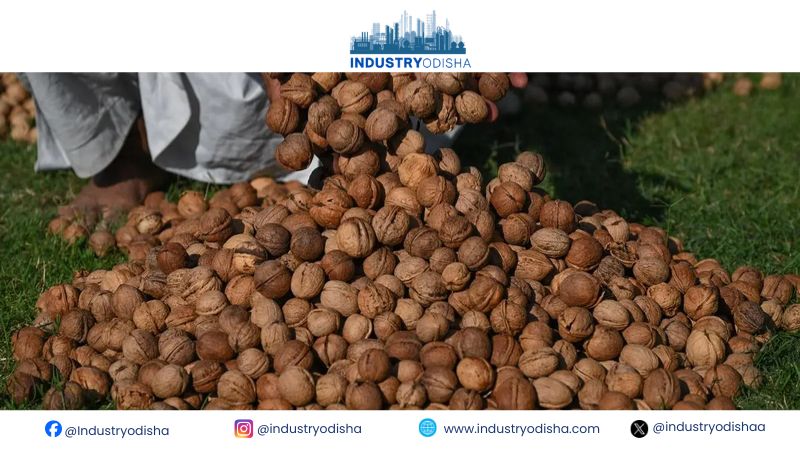
Industry Odisha Bureau, Sep 03: Kashmir’s walnut growers are harvesting a strong crop this season, yet returns remain weak. Cheap imports and ageing orchards are squeezing farmer incomes across the valley. Growers say cheaper imported walnuts are undercutting prices for their local produce this season. Ageing trees are limiting productivity even as harvests remain relatively strong overall. The combination is creating a difficult economic environment for Kashmir’s walnut farmers.
Jammu and Kashmir produces more than 95 per cent of India’s walnuts. Annual output stands at around 3.5 lakh tonnes, according to official data available. About 89,000 hectares across the union territory remain under walnut cultivation currently. This concentration makes Kashmir central to India’s entire walnut supply chain overall. India ranks eighth globally in walnut production, trailing several major producing nations. Anantnag leads production with nearly 62,000 tonnes annually, followed by Pulwama and Kupwara.
Farmers blame cheaper imports from China, Chile and California for falling prices. A Kupwara farmer said good production this year still yielded disappointing returns. Local traders argue that import competition undermines years of orchard investment effort. Haji Bahadur Khan, a dry fruit trade representative, alleged smuggling through the Nepal border. These cheaper walnuts reportedly undercut prices for genuine, locally produced Kashmiri walnuts.
Ageing walnut trees occupy substantial land while yielding progressively lower harvests annually. Small growers increasingly struggle to generate adequate returns from these older orchards. Traditional trees can take over a decade before bearing their first fruit. Farmers say felling restrictions prevent them from replacing unproductive, ageing walnut orchards.
High-density varieties offer a potential alternative to slower-maturing traditional walnut orchards nationwide. These newer varieties can begin producing fruit within just four to five years. Closer spacing allows farmers higher yields from comparatively smaller plots of land. One Anantnag grower said replacing old trees could meaningfully improve farmer returns.
Walnut trees remain legally protected under a 1969 state preservation law today. Government permission is required before felling any healthy or fruit-bearing walnut trees. Authorities currently have no immediate plans to relax these long-standing legal restrictions. Farmers continue urging authorities to reconsider these decades-old felling restrictions in future. The Omar Abdullah-led government recently opposed a private member’s proposed amendment bill. National Conference legislator Altaf Ahmad Kaloo introduced the bill seeking greater felling freedom.
Abdullah defended existing protections, citing efforts to preserve walnut and chinar trees. He indicated amendments could be considered under conditions requiring mandatory tree replanting. Such a framework could balance conservation goals against farmers’ modernisation and productivity needs.
Kashmir’s walnut economy faces a structural challenge combining import competition with orchard ageing. Balancing tree conservation against productivity improvements remains a complicated, unresolved policy question. The outcome will shape farmer returns across Kashmir’s dominant walnut-growing districts significantly.
