



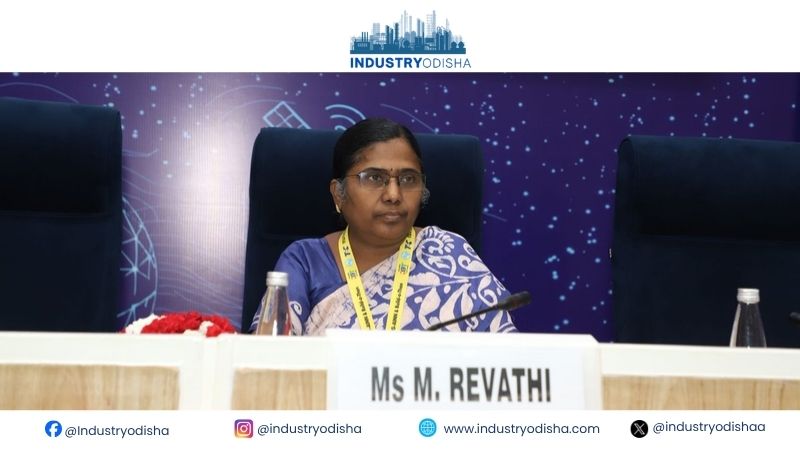
Industry Odisha Bureau, Aug 31: India is pursuing a major leadership role at the International Telecommunication Union this year. Revathi Mannepalli, the country’s nominated candidate, is contesting for director. She seeks to lead the Radiocommunication Bureau, one of ITU’s five top posts. Pakistan has publicly expressed support for her candidacy at a recent event.
Mannepalli currently serves as joint wireless adviser at India’s telecommunications department. She also sits on the ITU Radio Regulations Board as a member. Her rivals include Eric Fournier of France and Alexander Kuhn of Germany. The election happens at November’s Plenipotentiary Conference in Doha, Qatar.
Winners will serve a four-year term running from 2027 through 2030. If successful, Mannepalli would become the Bureau’s first woman director. She would also become the first director from Asia, Australasia and Africa. Analysts suggest two European candidates could potentially split their continental vote.
Pakistan’s Muhammad Amir Malik called Mannepalli clearly the strongest candidate for the position. He emphasised that India and Pakistan remain partners across international forums generally. This backing reflects broader diplomatic engagement rather than any formal bilateral commitment. Regulators elsewhere have also welcomed India’s candidacy, including Britain’s communications regulator, Ofcom.
The Radiocommunication Bureau coordinates global radio-frequency spectrum and satellite orbital resources internationally. Its mandate spans mobile networks, satellite constellations, aviation and scientific research applications. Satellite filings are reaching record levels, intensifying coordination challenges and interference disputes. This growing complexity makes the directorship increasingly consequential for global connectivity.
Mannepalli’s stated priorities include equitable spectrum access for developing and least-developed countries. She has highlighted the need for balanced innovation alongside interference protection measures. India’s own satellite ambitions add strategic weight to her platform. Reliance Jio has begun deploying its own low-Earth-orbit satellite network domestically.
She has flagged non-geostationary satellite constellations as needing revised coordination approaches. Traditional country-by-country orbital frameworks may struggle against expanding NGSO satellite systems. Regional coordination mechanisms could offer one alternative path forward, she suggested.
India last held ITU’s top post when Manohar Balaji Sarwate led decades ago. This renewed campaign reflects India’s expanding footprint across telecom standards and governance. Its outcome will hinge on regional coalitions, diplomatic outreach and member-state support.
