



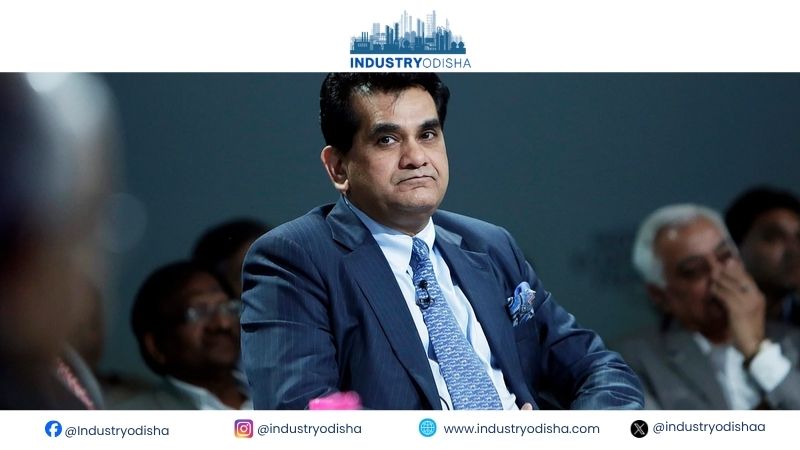
Industry Odisha Bureau, Aug 29: Former NITI Aayog CEO Amitabh Kant has criticised conventional CSR spending for its limited employment impact. He has urged Indian companies to back scalable, technology-driven rural entrepreneurship instead. Kant’s argument links corporate investment directly with India’s broader long-term economic ambitions. He wants rural job creation treated as central to that growth story.
Speaking at a Suzuki Motor Corporation event in Bengaluru on August 28, Kant argued India must move from a $4 trillion economy toward a $30 trillion economy by 2047. Achieving that scale, he said, requires large-scale entrepreneurship, technology, finance and rural job creation alike. Growth without accompanying jobs, in his view, remains an incomplete economic outcome.
Kant expressed concern that substantial CSR spending has often failed to generate meaningful rural impact. According to him, much of that spending has not translated into large-scale employment. He drew a distinction between simply funding social programmes and building enterprises capable of sustaining economic activity over time.
He highlighted Suzuki’s Next Bharat Ventures, a fund-of-funds initiative, as one alternative model. The initiative supports rural entrepreneurs through funding, mentorship, training and market linkages, Kant said. These backward and forward linkages connect entrepreneurs to suppliers, inputs, buyers and wider distribution networks. Kant described this combination as offering a scalable blueprint for sustainable rural livelihoods.
According to Kant, the model could meaningfully strengthen India’s broader MSME ecosystem over time. He said supported enterprises span sectors including agriculture, handlooms, handicrafts and animal husbandry. Healthcare, education and nutrition were also cited among the sectors covered. Each enterprise, he argued, carries a potential multiplier impact on surrounding communities.
Kant, who helped launch the Startup India movement in 2016, said government alone cannot create enterprises at the scale India needs. Government can meaningfully enable entrepreneurship, he said, but cannot substitute for private enterprise creation itself. Startups require finance, technology, market access and governance support to succeed, he added.
Kant urged other corporates to adopt and expand similar rural enterprise models. Such initiatives, he argued, need much larger scale to meaningfully shift India’s employment outlook. Whether this approach reshapes CSR more broadly will depend on execution.
Its success will likely hinge on enterprise viability, sustained finance and stronger market connections. For CSR to deliver deeper economic impact, Kant’s remarks suggest, social investment may need firmer ties to enterprise creation. That shift, if scaled meaningfully, could support more inclusive, employment-led rural growth across India.
